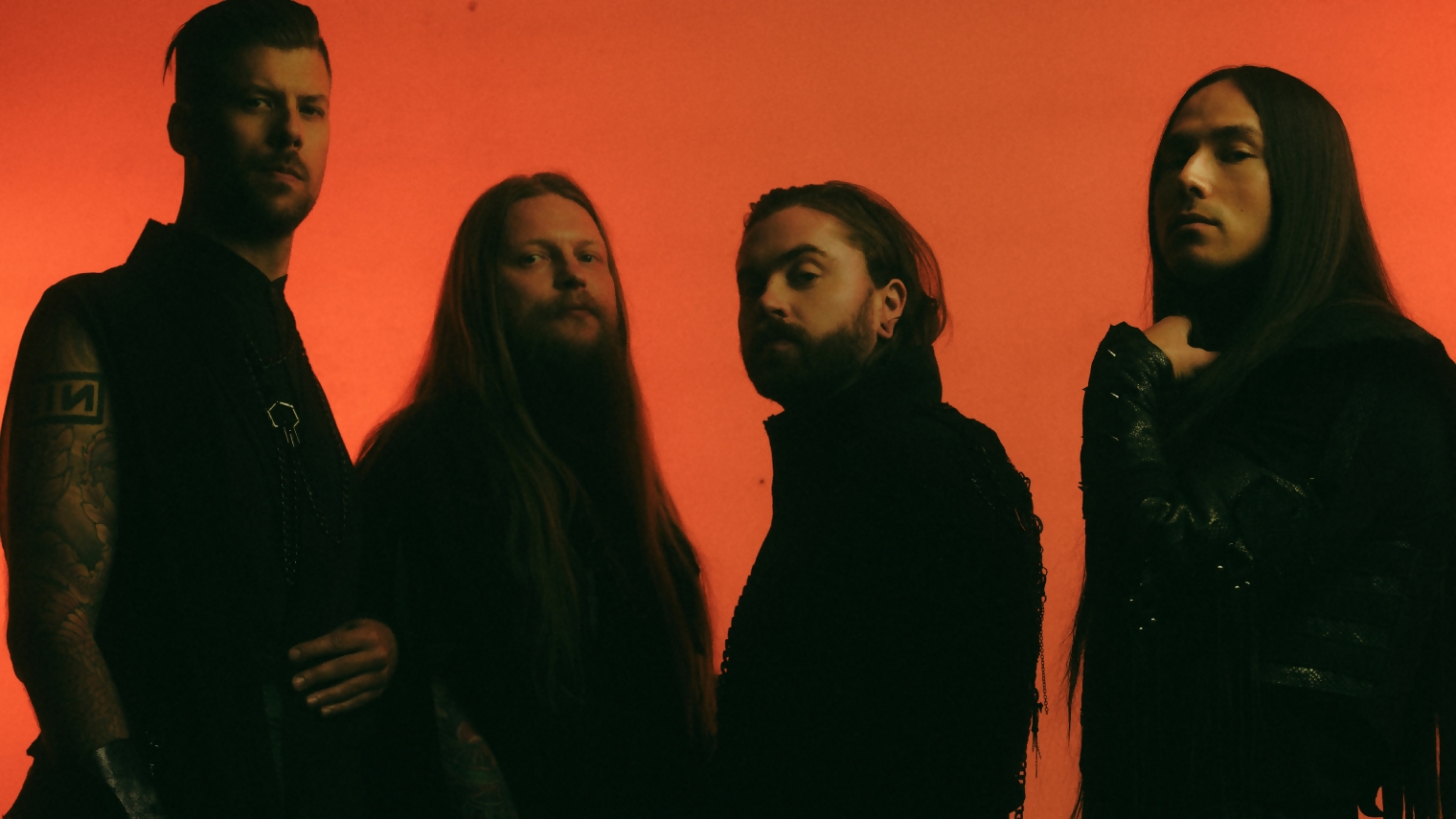
Never the prototypical black metal band, and hardly one these days, Enslaved are models for how to age gracefully and expand artistically. Their upcoming 17th album Mið is minorly different from its predecessor Heimdal in that it was entirely written in the studio rather than meticulously planned beforehand. It’s slightly floaty but retains the group’s signature gritty, progressive, and Nordic aesthetic. Long have Enslaved stayed within the realm of Norse mythology and culture, consulting with scholars and archaeologists to burrow deep within it. Mið is their first step outside that realm, venturing to the lands between their mythology and those of their collaborators.
Enslaved worked with Sami singer Johan Sara Jr. and Kevin Kicking Woman of the Blackfeet Nation, the latter of whom they connected with through Fire in the Mountains. Although musically interesting, Mið excels when it finds common ground between cultures. For instance, “I Am Ice” invites Sara Jr. into the Enslaved mythos and showcases how traditional Sami vocals fit into the Nordic culture that followed it. “Spirit Helper” inverts that relationship. Enslaved tailored the song around Kevin’s morning prayer song, adapting their string tunings to him. They modified themselves because Kevin placed his trust in them.
These tracks, and Mið as a whole, demonstrate the nuanced relationship dynamics between cultures; how separate regions and peoples arrive at similar conclusions, like Darwin and Wallace both hypothesizing natural selection independently. They are less interested in comparing beliefs and more so in presenting their harmony. Discussions of culture, heritage, and traditions in black metal can be dicey, and for good reason. Guitarist and songwriter Ivar Bjørnson spoke to us about how that needn’t be the case, explaining how we have been learning from each other for centuries and, ultimately, all seek to connect with the earth.
…
…
You said to Decibel, “Every tradition has its own history and its own identity. I’m not interested in saying, ‘This is just like Norse mythology.’ It isn’t, and it shouldn’t be.” How did you make sense of Kevin Kicking Woman’s spiritual perspective without immediately connecting it to pagan or Norse mythology?
I think our motivation, and through that, my own, and the way we’ve come to regard these things is as follows:
If we jump back to 2012 with RIITIIЯ, this thought or way of looking at things as a walk or hike in both geography and time, time stretched out along the path of these great migrations, and seeing where we are, we are a very young mythology up in the north, and what we know as Norse mythology, what was written down, it’s mainly from the years 400 to 700. So, it’s a very warrior-like focus with Odin on top, Father of War, which makes sense if you see it in the context of the great hungers and Fimbulvinter, the eternal winter. There was a lot of strife and fighting for resources. But before that, it might have been quite different; more focused on apples and poetry and skiing (laughs).
It’s interesting because here, the Germanic tribes that ended up being Norwegians, Vikings, all that stuff, they also met some people, like the Sami people who were already here. Contrary to what the populist sentiment of the previous century claimed (i.e., the Vikings would pop out of the ground and be these pure beings with the holy mythology), the Germanic tribes were inspired by the Sami. And the Sami, the indigenous people of the north, were very generous in sharing their mythology and their esoteric stuff. If you want to look at it as a business, they were very forthcoming and gave away their secrets. Having that perspective, it shows that we all, our roots, have been at one place at some time and then started wandering off.
So these narratives and this mythology— what is mythology? For us, it represents the psychic, psychological, metaphysical, esoteric history of our mental constructs. It’s easier to understand oneself the closer you get to where things come from. The Native Americans went eastwards over the Bering Strait and were at Turtle Island, the American continent, while some of us then turned west and north.
Talking to Kevin, who tells us about history, about the songs and the meanings of things, he’s part of a tradition that’s been unbroken for 15 to 18 hundred years. While we Norwegians are just rediscovering our own mythology. Just 15 years ago, it was quite problematic because there was still the stigma of right-wing politics associated with it because of what happened in the Second World War and after that. Now, in this year’s FIFA World Championship, the Norwegian national team had runes on their outfits, and they’re doing the Viking rowing thing. You should have seen how it was in Norway, it was just insane. People would gather everywhere and do that. And that’s what we wanted to happen, 35 years ago when we started with this concept. It’s a great thing. Kevin is a very good example of that, and just the generosity of sharing wisdom.
But, the learning point of all this turns out to be a lot simpler than maybe I’ve thought about before. It’s this–how do you get closer to your real, natural state? Isn’t that what we’re looking for? I guess why people are so ready for things like Fire in the Mountains or experiences going out in the wilderness is because that’s where we come from. We are part of nature, and that’s why it makes us happy when we find little green lungs in the middle of cities. It’s a beautiful thing because we are part of nature. And the connection isn’t that complicated. It’s just about noticing more in everyday life.
When I think of Enslaved or Norse mythology, I always think of ice, forests, lakes, very cold stuff. Very different from the setting of Fire in the Mountains and Kevin Kicking Woman. When you were making Mið, were you thinking about geography as well?
Yeah, I would say we were on the song “I Am Ice.” We have a Sami guest there, Johan Sara Jr., who says that he’s utilizing a form of Sami singing that’s archaic and primal. It’s all about elements. This song, “I Am Ice,” is a reflection in all its simplicity. Like ice, as you said, there’s a lot of ice in Norse mythology, and in the runes, there’s the 14th rune, Isa. We’ve done a lot with that one, and it’s a powerful concept of all kinds of change, whether it’s like modern self-help, or if it’s more esoteric, or it’s Aleister Crowley stuff with wands and people in awesome robes and hats. It’s all about getting from one place to the other. Changing, becoming something other than what is now. But this concept of ice in this esoteric knowledge deals with the beauty of preservation. Some things that you want to change and evolve don’t mean that everything needs to change. There is always something good. And that’s also a comfort, I would say. There’s a comfort in the concept of something frozen and solid. That’s at the core of “I Am Ice.”
As we started working more with the song, Grutle had been up in the north some years ago and spent some time there with Sami singers and learning about the traditions and learning the techniques. He’s very fond of that and found a great inspiration in that. When he suggested the singing technique and made some demos with it, it fit beautifully. Then, we needed to find and invite the Sami singer. And it turns out Iver (Sandøy), our drummer, who’s also a record producer as his job outside of Enslaved, had recorded it. He recorded with Johan Sara Jr. beforehand and had the recording on hand. That’s sometimes how the world works.
So, the difference between “I Am Ice” and “Spirit Helper” is that Kevin gave you his singing contributions first, and then you wrote it. Whereas with Johan, you had most of the song composed and then he gave his contributions. You can hear the one with Johan sounds a lot more like a traditional Enslaved song, but the Kevin song is very much his. I remember you said somewhere that you had to not base it so much on the rhythm but the language, right?
Exactly, because he wrote “Spirit Helper” 20-something years ago and he’s been singing it every day as his opening of the day. He decided this is the song that he wanted to take into the collaboration. We met in New York in October ’25 and he did a little ceremony and then gave me the song in the way he sang it. I recorded it there and then on my phone. He said that I can do whatever I feel. Actually, what he said is, “I know you’ll do the right thing, so you’re totally free to do whatever you want with it.”
He put quite a lot of faith in you, then?
Total faith. It ended up being that the right thing to do was nothing. I came home, put it into my little composer studio, and just sat there looking and thinking, “I cannot cut in this file or alter pitch, tempo. I can’t do anything. It’s just got to be what it is as it was recorded.” That’s what we said when we handed it off to Jens Bogren for mixing.
For the song, we tuned to drop-D sharp, which is not exactly like standard blues tuning or anything. It’s a little bit weird. But what happens when I check it? Kevin’s singing in exactly our open string tune. When I tell him, “This is crazy,” he goes, “No, of course, that’s just natural, that’s how the universe works.” That’s a typical Kevin response. So yeah, then I got some books, and that reminded me of when I was there in ’25. One of my other Blackfoot friends gave me a book to read, and it’s called Blackfoot Physics, which is really interesting. It’s about Western scientists going and living with them for a long time, one of the northernmost Blackfoot tribes up in Canada, and making the case to say, if you look at Blackfoot metaphysics or mythology through the lens of modern quantum science, then they actually make a lot of sense. It’s not all fantastic. Not fantastic as a good, bad, but fantastic as a made-up thing. It’s not all that fairy tale-ish anymore if you apply quantum physics to it.
…
…
If you’re trying to keep our cultural roots and ancestry, a lot of that can get warped by bad faith actors, as you said. You have always been open-minded and you’re collaborating with different cultures and doing so in a way that mixes and respects them. When you’re looking at these past ideas and traditions, what is the difference between how you see them versus signalling nationalist, reactionary stuff?
For me, the test is always quite easy. The ideology or the idea is probably good if it has a movement somehow. It can be destructive. It doesn’t have to be, let’s say, positive. I’ve been in this discussion when we talk about art and the question is, “Does art always have to lead to positive things?” What about art that is promoting the death of the planet or something like that? What if some art is going, “Oil is great, they should be sucking up more oil and burning more rainforest?” Is that automatically bad art? Probably, yeah, but it’s still art in a sense.
But where the line goes, it’s something we have reflected a lot on. Aleister Crowley, with his phenomenal robes and hats again, he advised do what thou wilt, right? As that’s been quoted so many times in the world of metal. And it’s a fantastic thing to live by, but it’s so misunderstood. It sounds on the surface like you should puke in your neighbor’s shoes and piss in his hallway because you can do exactly what you want. But the thing is, you’re limiting when you’re acting bad, limiting other people’s freedom of action. That’s a very different thing from freedom. I believe that 100% freedom is unattainable, of course, as long as you talk about more than one individual, because we all have to make sure that our freedom is not limiting other people’s freedom.
And that’s where you come in with this national pride and culture. Mythology is saying something about the temperament, the suspicions, the weaknesses, and the strengths. Norway can be very, on the surface, conformist. When we have people coming in here from other parts of the world, it’s an interesting question. Norwegians, they always go, “You should put on this Norwegian costume and eat Norwegian meatballs and be Norwegian.” America has traditionally been, “Keep wearing your crazy outfits from wherever you come from, and we’ll just be Americans from different places.”
I think Norwegians, we’ve been afraid of our history because it’s ended up, especially with how the Nazis used it. We become a little bit scared of the whole thing, and that makes us suspicious of people who have strong identities when they come in colorful costumes or have weird rituals and all that. But I think going in the direction that things are going now, that we are more open, not only during soccer championships, but in general; knowing our background and loving it for what it is, being proud of it for what that is.
It’s a big difference from saying, “I’m proud to be of German heritage and I eat white sausages on Thursdays.” Where is that reasoning going? It leads to, “if you’re not doing that, there’s something wrong with you and you’re inferior because you’re different.” It doesn’t really make sense. I don’t really buy it. I think they’re using something that on the surface looks like an easy way to hide pure uncertainty and hostility and existential angst. The world is too scary a place, things are too unpredictable and connectivity is lost. You don’t know where you come from. So, you feel like you’re drifting alone in the world. And then acting out this childish fantasy of putting on a uniform that’s different from the other guy’s uniform and then saying this is reason enough for me wanting to kill you or send you out of whatever country you’re in because you look different. It’s just, I don’t really buy that it’s genuine.
When you’re looking at preserving cultural ties and a cultural norm versus progressing forward, is there a line there when it gets too harmful?
If you’re going to be real about it and if you really mean that you want to preserve your culture and that it has a place in the world and it’s a valuable thing to teach your children and so on, you have to be critical. I’m not a revisionist. There are so many things that are worth looking back at. It’s a typical thing when you come to the whole concept of slavery, for instance, in the Viking Age. These discussions tend to go a little bit sour. Revisionists say, “Yeah, but slaves had social mobility. It was fantastic because a slave could be given his freedom and then he would get all these fantastic rights.” But there were still people being born into having to serve people with different surnames. It reminds of the Indian caste system. Their last names would bind them to a social standing for most of their lives. And yes, there were incidents where they were promoted and given freedom and all that, but it’s still pretty problematic. They had the same ethos of what they did in war that people still are doing; using sexual violence, for instance, as in, in most wars during history. If you’re going to go and say that it’s time to re-establish a Norse way of thinking, I certainly wouldn’t vote for the version where you just blindly implement whatever they were doing in the year 900 and say, “Let’s do that just with electricity and cell phones.”
We have a lot of ground to cover there also, but that’s also the problem. If you say that there’s a problem with certain aspects of a culture, people confuse that with racism, all kinds of phobias are immediately called into play, and people lose their heads. It’s a very bad climate for discussions these days in the world, I would say, except for interviews like this where we can be civilized and have civilized conversations, which is great.
Other artists use the argument, “Oh, we’re just talking about our history. What’s wrong with that?” But it’s the way that they’re implementing it.
It’s often a lot easier than you think. It’s like the whole MeToo discussion when people go, “You can’t have a chat with a young secretary anymore because you’re gonna get cancelled or whatever.” Nah, it’s not really that complicated. There are a lot of people who hang around attractive young women all day and for years and years, and there are no accusations of anything inappropriate. I think people know. And it’s the same with this. If you’re using this argument of, “We’re just talking about history,” it’s like, nah, it’s easy to tell.
What did you think after performing at Fire in the Mountains? Did it make you feel explicitly more connected to a new culture?
Yeah, it’s the beginning of something. And that happened, I think, very early on, when the curiosity from both sides and the talking started, the connection was established. And then I think we are on our way to explore that further. It’s not all grandiose and a concept album. It’s personal friendships being forged and having a connection to the land. I think a lot about that just coming back after 2025 and coming back this summer. The first night we went down there to the lake and waded out there in the middle of the night. I just felt really really special.
It’s forming a connection to another place, which is really strange. It’s far away, but it feels really close. So I’m really excited to see where it goes. I’m gonna go back there both in musical terms, but also as a Norwegian dude going over to visit my friends and learn more and have fun.
…
Mið releases October 30 via Nuclear Blast.