(written by Islander) What are the odds? For the second week in a row one of our Friday premieres fell through at the 11th hour, leaving a hole in our schedule and free time I didn’t expect to have. As usual when these things happen, I have pivoted to pull together a roundup of new […]
Cam Cole made his name by seeing how much sound one person could make. Guitar, footdrums, a rough-edged voice and enough rhythmic force to make a street corner feel too small became both the music and the spectacle. The one-man-band identity carried him from years of busking into international touring, viral live clips, a cameo on Ted Lasso and the American Mileage documentary, where his path crossed with living blues figures including Bobby Rush, Jimmy “Duck” Holmes, R.L. Boyce and Kenny Brown.
Lost In Creation arrives at the point where that description is no longer enough. The blues is still underneath everything, but the fourth Cam Cole album opens more doors: grunge, alternative rock, psychedelia, folk, stoner-rock weight, studio atmosphere and moments of real vulnerability all move through the frame. The important part is that the expansion does not make Cole sound polite. The distortion still bites, the rhythms still lurch, and the record is at its best when the music feels a little dangerous and a little strange.
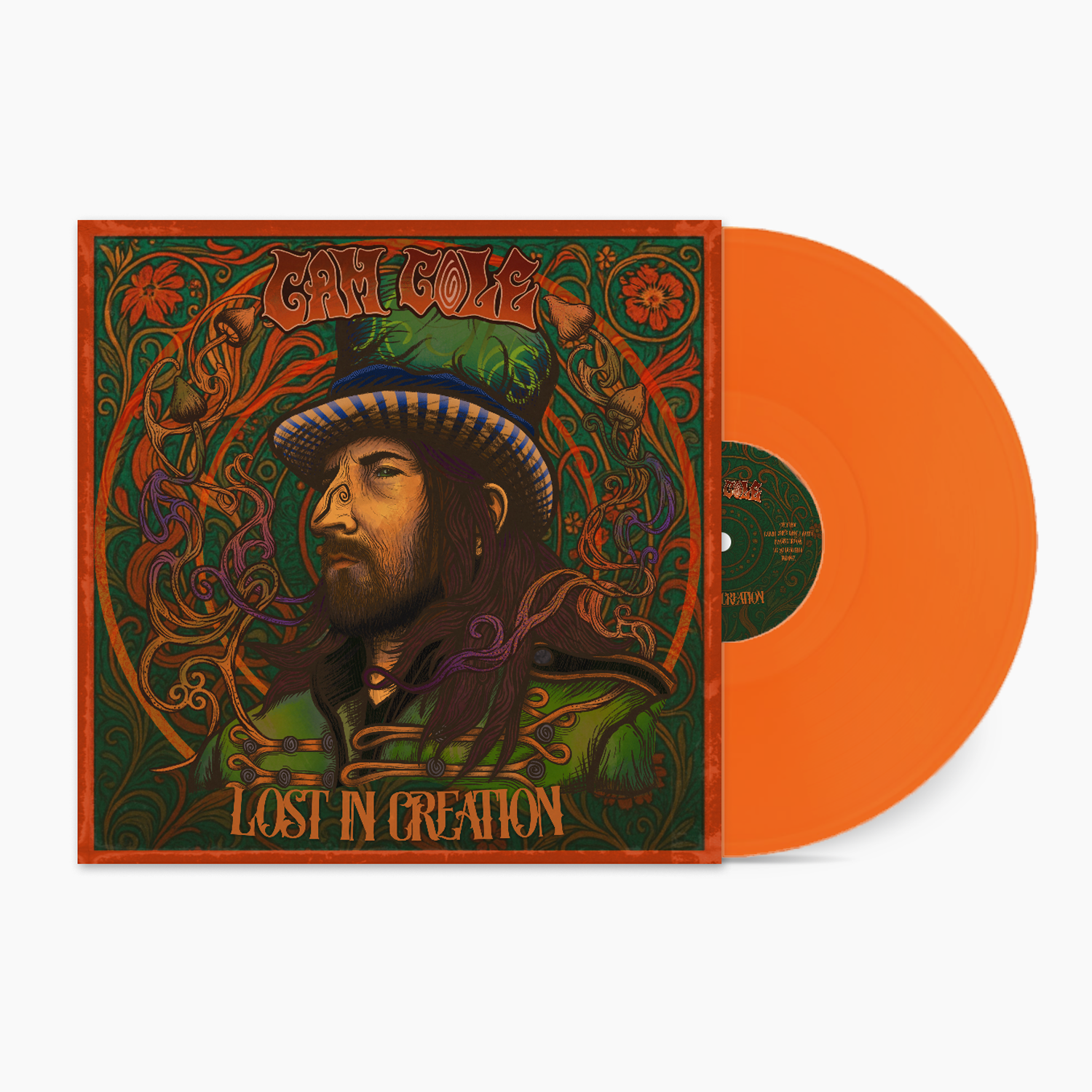
Lost In Creation album artwork supplied with the press materials.
The Wall Gets Wider
Cole says the change was deliberate. His first three albums were largely built around capturing the thing people had already responded to on the street: one person playing everything at once, with only subtle overdubs used when necessary to make a guitar sound thicker rather than to create an obvious second part.
“It’s the fourth album now. I could either keep doing what I’ve always been doing, or I could paint with it a little more and express myself in a way people haven’t really heard before.” — Cam Cole
That word — paint — gets close to what Lost In Creation does differently. Cole still records the core guitar and drums live, usually choosing the second or third take when the feeling is right. But now he is willing to build around that foundation with additional guitars and sounds. The raw performance remains the cornerstone; the studio becomes another instrument instead of merely a place to document the show.
That also means being willing to throw the foundation away when it does not feel right. “Get Up Ya Honky Tonk” became the problem child of this album. Cole went back to it, remixed it several times and kept hearing something he did not trust. Now he can listen and hear nothing wrong with it. At the time, however, it was the one song that refused to arrive easily.
A Record That Keeps Changing Shape
The opening run makes the new range obvious. “Fee Fi Foe” comes in dark and dirty, with grungy slide guitar, heavy distortion and a vocal treatment that sounds pushed through an old PA. There is some Jack White abrasion in the attack, but the stranger rhythmic personality keeps it from feeling like imitation. It is blues-rock dragged through fuzz, grime and a modern alternative-rock filter.
“Rabbit (She’s What I Want)” leans further into alternative rock. There are flashes of Nirvana and Corrosion of Conformity in the weight and texture, but the heaviness does not bury the emotional center. There is real longing in it — not just a lyric about wanting someone, but the sound of wanting someone. “Chasing Dreams” changes the temperature again with a catchier, more immediate pulse. It is one of the album’s most accessible tracks, proof that Cole can make the sound easier to enter without sanding off his personality.
“Ur So Beautiful” is one of the record’s most revealing turns. On first listen it carries the dark acoustic weight of the 1990s unplugged era — Alice in Chains and Stone Temple Pilots are fair touchstones — but Cole confirmed that the grunge intention is absolutely there. Delta blues may be the foundation of his music, he says, but grunge, psychedelia and a little Josh Homme-style desert rock are major parts of his vocabulary too.
“Grunge is a humongous genre for me… I especially like mixing the blues with the grunge.” — Cam Cole
The song came from a more personal place than its darkness might suggest. Cole wrote it while caught in the honeymoon-stage infatuation of a relationship that ultimately did not last. He walked into the studio with the feeling already present, turned it into a song and, with Valentine’s Day approaching, sent it to her. His summary of the result is considerably less poetic: “That got me in there.”
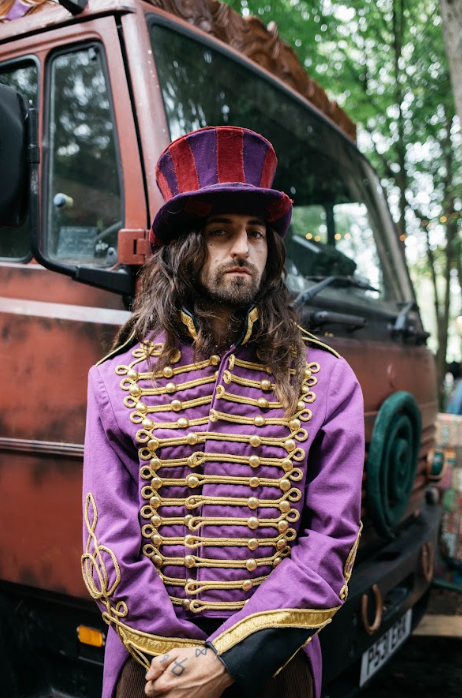
Cam Cole. Official press image. Photo: Tomm Morton.
The middle of Lost In Creation gets rougher and more playful. “Tailgate” piles on distortion and gives Cole’s vocal a near-spoken, almost rap-like cadence. “Feeling Me Now” seems to drag itself into motion before snapping into a faster, heavier groove, with rhythm doing as much work as the riff. Cole says the song also represents another small technical breakthrough in his foot-drum playing: a four-to-the-floor feel and double tambourines he had not previously been able to execute the way he wanted.
Then comes “Get Up Ya Honky Tonk,” the track that best explains what happens when Cole lets the weirdness stay weird. To these ears, it sounds like blues wandered into a Primus rehearsal: crooked, funky, stomping and playful, with raw guitar and a distorted radio-like vocal cutting across the groove. Cole laughed at the comparison because other people have told him something similar — and because he has barely listened to Primus. He knows a little of the band, but not enough to have consciously borrowed anything. That makes the rhythmic resemblance more interesting, not less.
The record works best when Cole lets the weirdness stay weird.
Mississippi, Slide Guitar and “Shroom Swamps”
Cole’s American mileage matters here, but not as a convenient explanation for the whole record. In the interview, he connected Mississippi most directly to the way he heard new possibilities in slide guitar and to the value of looseness — influences that became especially concrete in one instrumental.
He has long felt that slide guitar can do more than remain inside familiar blues structures. In Mississippi he became interested in bridging the recognizable architecture of 12-bar blues with different scales and chordal movement. Then a particularly strange day in the cypress swamps turned that theory into a song.
At an earlier show, a fan had given Cole psychedelic mushrooms. He forgot them in a pair of jeans. Later, during time off in Mississippi, he found them again while wearing those trousers and visiting the swamps. He ate them, discovered they were much stronger than expected, became increasingly aware of the possibility of alligators and retreated to the pickup truck with a camper body he was renting. There, guitar in hand, the musical idea clicked.
“It is exactly what it says on the tin. It was a psychedelic adventure in the swamps of Mississippi, and it was a sound I was looking for.” — Cam Cole on “Shroom Swamps”
Cole put down his phone and recorded what he was playing. That sketch became “Shroom Swamps,” later expanded with drums. It happened during the same stretch in the States when he interviewed Bobby Rush. The instrumental is one of the album’s most vivid pieces: creepy Delta-flavored slide, psychedelic atmosphere and the feeling of walking through mud with every step resisting the next one. On the record it sits immediately before the title track, functioning like a murky passageway into the final statement.
The trip also sharpened another lesson. Around Bobby Rush and R.L. Boyce, Cole heard musicians who were not obsessed with perfect edges. He was struck by Boyce’s willingness to let the playing get messy if the vibe was right. The takeaway was not to become careless; it was to understand that precision is not the only kind of control. “If you can save it in time, it sounds in,” he said. That looseness is now part of what he wants to carry forward.
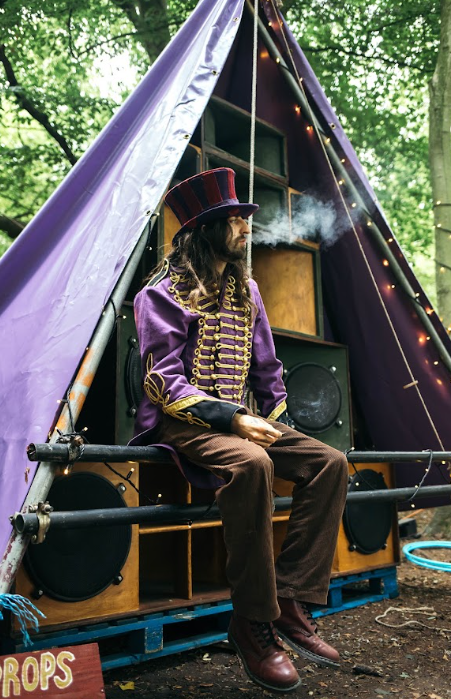
Cam Cole. Official press image. Photo: Tomm Morton.
The Work Is Part of the Show
Cole never planned to become a one-man band. The songs and the imaginary band in his head came first. After being repeatedly let down by drummers, he moved from a stomp box to adding a tambourine, then tried using both feet at once. Eventually he found the Farmer FootDrum and began the long process of teaching his body to do what his arrangements required.
The setup is now customized, partly because Cole hits it hard enough to break things. Pete, the builder, has helped modify the levers so they return properly, though Cole says he can still “break the bastard” and values having a tech nearby when that happens. Each record tends to bring a new beat or another piece of coordination he did not have before.
That difficulty is not something Cole wants to hide with electronics. He has considered simplifying his street and live setup into a smaller digital system, but he thinks doing so would remove one of the reasons people stop. He spent roughly seven years busking before the final three years became genuinely profitable. The difference, as he sees it, was not convenience. It was finally building a show where a passerby could look at the physical effort and immediately understand that what they were seeing was hard.
“People on the street don’t give you any time unless you’re giving them something. You’ve got to hypnotize them.” — Cam Cole
When that happens, the reaction still matters to him. Asked what it feels like to see someone in a crowd become completely absorbed, Cole answered without hesitation: he loves stopping people. “That’s what I live for.”
Away from the road, he is already writing again, working out the show for an upcoming February tour and continuing his “Sounds From The Van” videos. His restlessness reaches outside blues-rock too: he keeps an electronic dance-music project as another outlet for ideas that do not belong inside the Cam Cole sound. He talks about songwriting as capturing lightning in a bottle, and about the stage as something that can always be pushed further — even down to visual devices such as the large spiral wheel he uses behind him. The one-man-band concept may be expanding, but the instinct to make people stop and look remains intact.
Vulnerability, One Takes and the Rooms That Matter
The final three tracks deepen the record rather than simply making it louder. “You Shall Be Saved” begins stripped down and vulnerable, then widens without losing the exposed quality at its center. Cole wrote it in the same general batch as Unleash, but it was too singer-songwriter-oriented to belong comfortably on that heavier album. Lost In Creation gave it a better home.
The song dates to the pandemic period and the collective feeling of watching livelihoods, small businesses and ordinary stability disappear. Its message is not that music magically fixes any of that. It is that if some part of you can still sway to the rhythm, there is at least something to hold onto. Cole admits he may have been trying to pick himself up as much as anyone else.
The performance has another layer of significance: the main vocal, guitar and drums were captured together in one take, with only a few backing vocals added later. That raw ending, where the vocal seems to lose itself inside the song, is not studio theater. It is the core performance itself.
“You Shall Be Saved” was recorded at Rockfield in Wales, where Cole also recorded Unleash. He points to the studio’s history with artists including Queen and Oasis, but what he values most is the ability to live there for a stretch, wake up and immediately work rather than carry the outside world into the room. Most of Lost In Creation, however, was recorded at Dean Street Studios in London, with Markus Stretz producing and mixing, and Sean Magee mastering at Abbey Road.
“You only get to do this once with these songs. I could record them all at home on my laptop and a microphone, but there is a fucking difference.” — Cam Cole
For Cole and Stretz, that difference is the room. They are self-described music nerds who care about how drums, guitars and voices react to a physical space. Dean Street and Abbey Road are not status symbols in that telling; they are tools. Cole points out that sometimes the magic space is not even a studio — it can be a corridor, a staircase or any place where the sound suddenly becomes bigger than the walls around it. He cites the famous stairwell sound behind John Bonham’s drums on Led Zeppelin’s “When the Levee Breaks” as the kind of accidental acoustic discovery musicians spend their lives chasing.
Getting Lost Without Losing the Stomp
“Shroom Swamps” needs no lyric at all. The title track that follows it does. “Lost In Creation” turns the album’s outward experimentation inward: darker, more reflective and lyrically direct, it sounds like an artist confronting the quantity of ideas in front of him and the difficulty of knowing which direction deserves to survive.
That is also why the album’s breadth works more often than it does not. What could look like genre-hopping across ten songs gradually starts to feel like the point. Cole is allowing himself to chase sounds until they tell him where they belong. The one-man wall of sound has become a room with more doors in it.
The record is not flawless. Its breadth can occasionally feel restless, and the distorted vocal treatment appears often enough that what begins as a striking texture can become expected. “Chasing Dreams” is immediately likable but less idiosyncratic than the album’s strangest material. Those are modest trade-offs for a record that is clearly trying to grow instead of simply repeating a successful formula.
The standouts are “Get Up Ya Honky Tonk,” “You Shall Be Saved,” and “Lost In Creation,” with “Shroom Swamps” functioning as the odd instrumental detour that gives the album a world of its own. More importantly, Lost In Creation answers the question hanging over the project: Cam Cole can expand the palette without losing the stomp. The blues is still underneath everything, but it is no longer a fence.
At the end of the interview, Cole resisted telling listeners exactly what they should understand about him when the album ends. That, he said, belongs to them. What he hopes they hear is the journey — the different flavors, the things he is pulling in, and the work of creating each song on its own terms.
“I hope they understand the musical journey I went on to make the album… Anything else they take from it is a bonus. That part is up to the individual.” — Cam Cole
That is probably the right final word. Lost In Creation is not a clean arrival at a new identity. It is the sound of an artist discovering how much more the identity he already built can hold. Getting lost, this record argues, is not the same as being defeated.
And Cole does not sound finished with the journey. As the conversation ended, he said he expects to return to the United States soon. For a musician whose career began by forcing strangers to stop, the next chapter may be less about proving how much noise one man can make and more about seeing how far that noise can travel.
Stream and buy Wyrm Chasm on Bandcamp Dallas black metal quartet WYRM CHASM have released their self-titled debut album independently on vinyl, CD and digital formats. The eight-track record is out today, 23 October 2026. Physical editions include 180g black vinyl, listed on the band’s Bandcamp page as an edition of 100, and a jewel […]
SERPENT SKIES have shared ‘Where Is Your God’, the second and final single from their forthcoming album, Hollow Crown, due on 20 November 2026. Following ‘The Colors of My Truth’, the track turns towards faith, doubt and the collapse of previously dependable beliefs. The release announcement describes a song concerned with what remains when familiar […]
Thank god for the weekend! It’s feeling like winter is rapidly approaching this week, but we’re not quite at the end of year yet with plenty of brilliant new albums to sink our teeth into as we hit the penultimate week of October.
That in mind, here’s the results of last week’s vote! Blackgold brought glory to the nu metal revival with Killaz landing a top three position (and if you like that, check out the last two tracks this week!), while Aussie newcomers Nika landed at number two. But ultimately, the crown could only go to the original symphonic metal queen as Tarja teamed up with Apocalyptica for something truly epic in Tango.
We’ve got a diverse bag for you again this week with new singles from Floor Jansen and Delain, plus a surprise drop from Machine Head. There’s also a healthy showing from emergent and underground bands, so don’t forget to cast your vote in the poll below – and have an excellent weekend!
Floor Jansen – Everything Is Moving On
It probably would’ve been a bit on-the-nose for this to have come out with last week’s shock announcement that Floor Jansen had left Nightwish, but Everything Is Moving On feels like a perfect summation of the confident way the singer is approaching the future. More a pounding, triumphant old school metal track than the usual symphonic grandeur, it’s a great showcase of her powerful voice and shows how she’s expanding her repertoire on upcoming solo album Hytress, due January 15.
Delain – We Are Fire
Talk about a rough month for symphonic metal fans. Diana Leah has announced her departure from Delain after 2023’s Dark Waters introduced her as the new singer of the group. Rather than recruit a direct replacement, Delain have announced plans for a star-studded new album that will feature figures including Marko Hietala and Sharon Den Adel. First single We Are Fire sees bandleader Martijn Westerholt recruit Eluveitie’s Fabienne Erni, Italian singer Paolo Ribaldini and Noa Gruman of Sabaton’s Legendary Orchestra for a typically bombastic and grandiose song.
Evil Invaders – D.S.S. (Death Strikes Suddenly)
Get some thrash in you! Kicking off with a delightful Araya howl, Belgians Evil Invaders are leaning hard on 80s speed with new single D.S.S. (Death Strikes Suddenly). If you’re reeling from the recent death of Cronos, this might tackle the evil itch nicely, new album Weaponized Chaos set for a February 19 release, with the band touring the UK with Heathen the following month.
Vindicta – Idol(l)s
It’s been a year since the line-up of Dogma fractured, and a little under that since former members of the demonic nun group formed Vindicta. Now they’ve announced they’re signed to Napalm Records and put out new single Idol(l)s, a track that adds a spikier edge to the music they were making in their previous incarnation, seemingly poking fun at the situation its members found themselves in.
Machine Head – Sutures
Robb Flynn’s barely let the dust settle on the Unatoned era and is already teasing new music. Sutures is a surprise new single from Machine Head, and feels like an especially feral and vicious release from the group, its hardest edges only slightly blunted by some big, chest-beating melodic passages.
Zilqy – Misfit Toys
Zilqy continue to be one of Japan’s most difficult to pin down metal groups. On new single Misfit Toys the band mix hyperactive beats and heavy breakdowns with joyous, typically Japanese melodic choruses to great effect. Taken from the band’s debut Birth Of Riot – which came out earlier this month – it shows they’re another bright new voice to emerge from the island nation.
The Yagas – Runaway
It’s been almost exactly 18 months since The Yagas released their debut album Midnight Minuet, a gloriously dark alt. metal album that saw actress Vera Farmiga embrace her inner goth. Now the group are back with a new single in Runaway, going full 80s with heavy synth and beats that feel like they should’ve been threaded into the DNA of movies like Lost Boys or Near Dark.
Shooting Daggers – T.R.L.T.
A short, sharp blast of 80s style hardcore punk, London’s Shooting Daggers don’t really need to reinvent any wheels when they make music this viscerally satisfying. Belligerent in the very best way, it’s a great demonstration of this band’s infectious energy.
Defences – Death Of A Dream
Defences are going big on old school nu metal vibes on Death Of A Dream. Chunky, downtuned guitars that make you want to bound around a pit, little record scratches and even electronic effects on Cherry Duesbury’s vocals, it feels like a single that easily could’ve come right as the new millennium hit, but also doesn’t feel dated for the fact.
Dead Signal – Follow The Signal
Sticking in the realms of nu metal inspiration, Italy’s Dead Signal are combining the genre with explosive metalcore to great effect. Sounding like a collision of debut-era Slipknot and Impossibility Of Reasion-era Chimaira, Follow The Signal is the band’s debut single and has us excited to see where they go next.
UCHAYE opens “WAR IS OV3R” with an invitation to leave reality behind. “Denial (Interlude)” introduces reverberating guitars that carry you into another dimension. Then her voice appears, ethereal and mysterious, almost hypnotizing you as it floats through the arrangement. It is an atmospheric entrance, and you can already sense the fire waiting beneath the surface.
That fire comes alive with “Denial.” A gripping guitar riff and pounding, almost ritualistic drums change the atmosphere. The rhythm surrounds you, and UCHAYE moves through it with confidence. You immediately understand that the sacred flame of rock burns in this artist’s heart. There is conviction in the way she delivers this music, and that attitude makes you want to turn up the volume.
“Survive” pushes the energy even higher. The fast rhythm carries a touch of early 2000s punk, bringing back memories of a time when guitars poured out of car stereos and every chorus demanded that you sing along. There is a nostalgic feeling running through this song, but the contagious pace keeps your body firmly in the present. It is difficult to sit still while listening.
WAR IS OV3R – Sound and Atmosphere
“Currency” reveals another side of UCHAYE. The production moves closer to pop, with a more mainstream approach that gives the EP a different flavor. Her personality remains recognizable, though. She brings her cultural background and musical passions into the song, making this change of direction feel natural.
I liked this contrast. After the urgency of the previous tracks, “Currency” gives you another way into her music. UCHAYE sounds comfortable exploring different ideas, and her presence connects the atmospheric passages, the rock intensity, and the pop elements.
Then comes “Live Wire,” and this closing track hits hard. A powerful guitar riff leads the charge while the drums strike like a blacksmith hammering an anvil. You can almost feel the sparks flying. The rhythm has weight, the guitars have bite, and the whole song makes you want to grab a motorcycle and disappear down an American highway.
WAR IS OV3R – Performance and Production
“Live Wire” is a song for renegades, for those moments when you need open space and loud music. It closes the EP with the kind of physical energy that makes rock so satisfying. After the mysterious opening, arriving at this final explosion feels especially good.
Across these tracks, UCHAYE shows versatility and a clear musical identity. Her voice can draw you into a dream, while the heavier arrangements bring out her rebellious spirit. The production gives each song its own character, allowing those different sides of her personality to emerge.
“WAR IS OV3R” introduces an artist with fire, taste, and the confidence to follow her instincts. From the reverberating guitars of the opening to the hammering finale, UCHAYE kept me involved. An EP I recommend to anyone who likes their rock passionate, melodic, and ready to hit the road.
In the summer of 2006, My Chemical Romance came to England to play Reading and Leeds festivals, and to tease their forthcoming third album, The Black Parade, with a special headline show at Hammersmith Palais in west London on August 22. That night the New Jersey emo quintet gave live debuts to two songs from their forthcoming record- I Don’t Love You and Cancer – and showcased three further songs from the album, The End,Dead! and House Of Wolves. It was immediately clear all in attendance that the band’s follow-up to 2004’s Three Cheers For Sweet Revenge was going to be something special.
Later that week, Metal Hammer‘s Katie Parsons caught up with Gerard Way’s band backstage at Reading festival to get the inside story on an album that would soon be recognised as their masterpiece
The backstage field at the Reading Festival is a hive of activity. The guest area is awash in drunken squeals and bloated, beered-up bodies. The occasional ‘funny hat’ lurches by, and the multitude of dancing ladies in the warm light have suntanned ankles clamped into bright floral rubber boots. It may only be mid-morning but the party is already well underway.
Take two steps to the right, however, past a stern-looking security guard, and the green trailer sheltering New Jersey superstars My Chemical Romance houses an entirely different scene.
“A friend of mine killed himself by standing in front of a train,” someone whispers from the corner. “He was 15 years old.”
Donned in black from tip to toe (barring his new blond locks), Gerard Way and his four accompanying musicians (guitarists Frank Iero and Ray Toro, bassist Mikey Way and drummer Bob Bryar) are slouched on a couch, sipping sticky cups of brown soya milk from the small selection of food provided for their pleasure. They’ll be clambering onto the hulking main stage at Reading in 30 minutes’ time. It’s the biggest show they’ve ever played in the UK. Given the cheery excitement just metres away, and the potential exhilaration awaiting them up in front of the gathered thousands, the last thing you’d expect to be talking about is suicide. But darkness seems to overshadow My Chemical Romance wherever they go.
“We actually tried to stay away from death,” says the permanently sullen singer. “We just couldn’t do it.”
Gerard and the band are chatting to Hammer about their upcoming new release The Black Parade – the highly anticipated follow-up to the group’s 2004 release Three Cheers For Sweet Revenge and 2002’s I Brought You My Bullets, You Brought Me Your Love. Thrust into global stardom following a series of massive hit singles and the adoration of a globe-spanning fanbase, My Chemical Romance may see the The Black Parade becoming their biggest and most important album to date.
This is the most theatrical record we have ever made. It really is the record of our dreams.
Gerard Way
“This is the most theatrical record we have ever made,” says Gerard quietly. “It really is the record of our dreams. Just like the other two, it’s a concept album, but it’s the tightest of all three. While the last record was an examination of immortality, this new one looks at mortality. Yes, we have written about death again, but in a much more mature way.”
Why can’t MCR avoid such morbid thoughts?
“Everybody is afraid of death. It’s just that maybe we’re a little more afraid of death than most people,” explains Mikey. “Everyone is going to die. That’s the one thing that absolutely everyone has in common. It’s universal. Death is kind of like the unknown, and I think, as a band, and on this record, we are influenced by the unknown.”
The album’s concept tracks the experiences of a character called The Patient, a narrator who My Chemical Romance use to help weave their shadowy ideas, lyrics, melodies and musical visions.
“At the very beginning of the record, The Patient is dying tragically young in a hospital,” explains Gerard. “Death then comes to him in the form of a parade, because his strongest memory of childhood is of his father taking him to a parade. From that point on in the record, he examines his life, and he meets other characters in the parade that talk about their lives, and by the end, he is someone that chooses to live, as opposed to die.”
Sitting in the confines of the small trailer, the four other members nod in agreement.
“I think that one of our main goals in this band has always been to write songs from the heart,” says Ray.
“For me, it’s like a constant quest to write the perfect song,” notes Gerard. “My current favourite of our arsenal is the new song Cancer. I think it’s the most emotionally powerful song that we’ve ever written. It’s direct, it’s honest, it’s ugly, it’s beautiful, it’s the truth. We played it a few days ago and the response was immediate. People were so affected, it was like they weren’t able to speak for two minutes.”
The lyrics may be written by their enigmatic frontman, but the sentiment of the album directly reflects all of the band members’ urge to give a voice to their fans; a voice for those who might find themselves in a situation where they may be choosing between death and carrying on with life.
“It’s about making a difference,” says Gerard. “It’s about giving those kids a representative.”
It transpires that from the very beginning of their careers, the group have felt a responsibility to give a voice to those who dwell in the ‘dark side’ a little more than others.
“We were originally united as a group because we ourselves were obvious outsiders,” explains Gerard about the band’s dark beginnings. “We were pretty much invisible and insignificant. When nobody pays any attention to you, you realise how mortal you are. That’s why teenagers that are troubled or are seen as outcasts are drawn to death. You have a lot of time to examine that subject when you’re all alone.”
Gerard and his bandmates are now in the lucky position where they can turn their own ‘outcast’ experiences into guidance and relief for others.
“We were people that were able to rise above those feelings,” he explains, “and with our help, others will be able to rise above that too. That’s why we have such a strong relationship with our fans. We can understand.”
We were originally united as a group because we were obvious outsiders. We were pretty much invisible and insignificant.
Gerard Way
Were you shocked into taking action by those that didn’t survive?
“The suicide of my friend was something that really changed my life,” he agrees. “There was a really strange wake where there were all these kids from high school there, all of his classmates – kids. That was strange. That set me on the path of wanting to escape that kind of life in New Jersey, the feeling of being depressed and insignificant.”
Come summer 2006, the band are about as far removed from insignificance as it’s possible to imagine, and the main stage at Reading is about as big at it gets for any band. As for being depressed? It’s hard to accuse Frank, Gerard, Ray and Bob of laughing too much. But Gerard’s little brother Mikey seems slightly more fragile. Throughout the interview, his hands are visibly shaking. His conversation is slow and considered.
“I am not going to diagnose myself, but I probably have ADD. I do have ADD, ’cos I am constantly wandering,” says the bassist.
“Mikey is the eternal kid brother of the band,” says Gerard, smiling at his brother. “He has a lot of heart and is just a bit shy and awkward. We’re very protective of him.”
Mikey also notes that Gerard requires protection as well, pointing out that historical frontmen often faced tragic fates due to a lack of support, and warns that without adequate backing, Gerard would likely flee under an assumed name.
That certainly contradicts the view that MCR is just another name for ‘Gerard’s band’. Though he has taken on most of the answers to the questions we have posed the group, it was made quite clear to Metal Hammer that the singer does not do interviews alone.
“We don’t want the emphasis to just be on one person. Bands are much more exciting than individuals,” laughs Gerard. “That’s why you start a band! And if you always keep that in your head, it’s that kind of unity that makes you stronger. When you just have one individual, that’s when people get depressed, people off themselves, and then you have one person carrying this intense weight on them and they’re this huge celebrity. They don’t have enough strength on their own; they need others. That’s the point of a band, of this band – we need each other. I think everyone in this group wants to carry our responsibility together.”
There is no time that this belief is more apparent than when the five members of My Chemical Romance get up on stage. Sure, Gerard is the ‘frontman’, the spokesman, the voice for the masses, but without the intense musical backdrop of his friends, he could be mistaken for just another madman on a rant.
“There is a degree of leadership that needs to be there on stage,” says Gerard, “and although it is one voice, it’s all of our voices speaking together. The music speaks for itself. The chemistry we have together is the real voice.”
To think there was ever a time when Gerard and the band were outcasts is hard to believe. Up in front of the gathered thousands, they’re worshipped like gods.
Each carries the audience in the palm of their hands, through their individual appeals and characters. There are banners being waved, and every word is sung back at the band with full force. Far from being insignificant, they are now the most notorious young men to ever come out of Newark, New Jersey.
“It was never about notoriety, never about fame,” insists Gerard not long after MCR step off the stage, drenched in their own sweat and bathing in the adoration of their fans. “However, we do seek a certain glory and victory in all this. There’s something really amazing about being able to get up on a stage like this and do this kind of thing.”
And who is this victory over? Is it hitting back at the bullies of your past?
“It’s less about the bullies and more about the victory of giving people like us a voice,” Gerard smiles. “And anyway,” he adds, “the bully is usually the guy that stays in the town, lives in the town, fucks in the town, drinks in the town, dies in the town. Whereas,” he grins, spreading his arms wide across the Reading field, “it’s usually the kid whose wearing black in the corner that ends up doing something significant.”
Half Foot Hog kick off “Wookies Beat Fascism” with “Six Forty Five,” and the sound immediately raises a middle finger to artificial intelligence. You can hear the hours spent rehearsing together, turning sweat and determination into punk this powerful and direct. The rhythm is fast and chaotic, with an urgency that makes sitting still feel impossible.
“Blowing Up The Bathroom At Braums” follows with guitars that practically grate your skin. Within seconds, you wish you were packed into a basement, surrounded by people sweating through their shirts, smelling of beer and armpits, and forgetting everything waiting outside. This music makes you want to get involved, push toward the front, and leave with your ears ringing.
“The Puker” brings an intense guitar riff with a sly attitude. I particularly like how Half Foot Hog play with the backing vocals, giving the chaos another voice to shout through. There is something physical and instinctive about their approach. The music entertains and fires you up, while the lyrics take their swings at authority.
Wookies Beat Fascism – Sound and Atmosphere
“Keto Diet” starts on slightly mellower ground, giving you a moment to catch your breath. That moment does not last long. Soon enough, the band throws everything into the blender again, and you are caught in another rush of guitars and drums. These musicians know how to build anticipation before sending the room sideways.
“Ukraine A Go-Go” is irreverent, powerful, and built like an anthem. Half Foot Hog tackle serious subjects with irony and a directness that suits their sound. The humor has teeth, and the energy gives their words an extra shove. You can laugh and still feel the anger underneath.
The album closes with “Sincerely, Dan Patrick,” a charging track with a strong dose of English punk in its veins. It makes you want to dance, knock back a beer, and surrender to the noise. The band keep pushing, giving the record a final burst of energy that leaves you ready to start it again.
Wookies Beat Fascism – Performance and Production
What I appreciate most about this album is the feeling of musicians feeding off one another. The guitars scrape, the drums drive hard, and the vocals pull you into the commotion. Even at their most chaotic, Half Foot Hog sound like a band that has put in the work. Playing with this much force takes commitment, and you can hear it throughout the record.
The backing vocals add to that sense of shared madness. You can easily imagine these songs coming alive in a small room, with the audience shouting back and the temperature climbing after every track. The recording carries that sweaty, close-quarters feeling.
In a world that often feels wrapped in plastic, “Wookies Beat Fascism” gives me hope. There are still bands willing to rehearse, make a racket, challenge power, and put their whole bodies into a performance. Half Foot Hog delivers punk with dirt under its fingernails, and it feels damn good.


 If you love this music:

