Xasthur reveal the third and final advance single, “Running From Silence”, from their forthcoming studio album Open To Misinterpretation. This self-recorded exploration of Dark American Folk is scheduled for release on October 2, 2026. Read more…
The Goth subculture has survived for nearly half a century partly because every few years somebody remembers that death can be absurd. Strip away that humour and the genre starts resembling a homeowners’ association for people with excellent boots: approved haircuts, approved records, approved photographs taken beside approved statues in approved cemeteries. Then Comes Silence have enough mileage behind them to recognize the danger. Remaker Redeemer finds the Stockholm trio Alex Svenson, Jonas Fransson, and Hugo Zombie treating the graveyard as a playground again.
Then Comes Silence fortunately remembers that a black shirt is still a shirt. The album itself is conceived as a diptych, with “Requiem” representing darkness and “Ballroom” representing light. “Everything exists in contrast,” the band says.
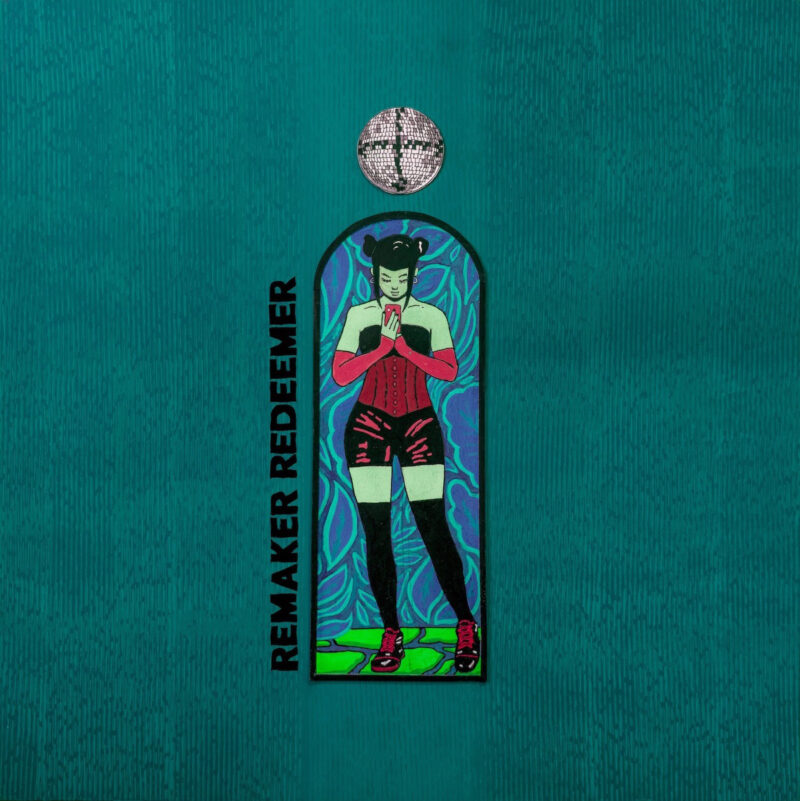
Remaker Redeemer introduces the “Ballroom” half of the band’s forthcoming Requiem Ballroom, due November 20. The band explains that the song “is about new life, being reborn with old sins washed away. A kind of cleansing, a fresh start, and the feeling of beginning again. The choice of instruments and sounds on this track was also a way to explore something a bit different this time.”
Svenson’s bass plants every movement firmly beneath the feet, while Fransson’s drums drive the song with a dark, danceable force reminiscent of Killing Joke’s Night Time era. Svenson’s grave, commanding vocals strengthen the comparison, while Zombie’s guitar cuts through with a bright, sharp edge. There is genuine pleasure in the performance, closer to liberation than solemn contemplation, which suits a song concerned with starting over. Rebirth here apparently requires amplification, eyeliner, and several people dressed as failed medical experiments.
The song’s lyrics treat death as a passage toward renewal, moving from surrender and darkness toward another existence. Closed eyes, raised hands, joined hearts, and the arrival of dawn suggest a collective transformation, while the repeated call to a remaker and redeemer turns rebirth into an act of cleansing: old sins washed away, one life surrendered, and another beginning on the other side.
The video makes the album’s concept pleasantly mischievous. Renewal takes place among monsters. Cleansing occurs in a room full of freaks. Life returns while death watches from the front row. Directed by Damon Zurawski of Future Legends Films, the video places the band before a congregation of ghouls, Droogs, demons, grotesques, and evil babies. Yes, evil babies that look like escapees from the bargain bin of some forbidden 1970s horror shop, which immediately gives the clip more personality than another five minutes of serious men staring into industrial fog.
Zurawski photographs the performance beautifully while allowing the absurdity to breathe. Svenson holds court on bass and vocals with severe composure while Fransson hammers away behind him and Zombie sends guitar across the room in sharp strokes. Around them, the assembled creatures stare, convulse, leer, and generally behave like the clientele of a nightclub whose liquor license was issued by Satan.
Watch the video for Remaker Redeemer below:
Rock music periodically develops the delusion that dignity equals importance, an especially fatal mistake for any subculture born from makeup, theatrical clothing, cheap smoke machines, horror films, and teenagers trying to scandalize their parents. The original punk impulse understood spectacle as provocation. Somewhere along the road, certain corners of underground culture began treating their uniforms with the solemnity of military dress.
That final joke may be the best one. Subcultures survive through mutation, bad taste, risk, exaggeration, and people willing to make fools of themselves in public. Then Comes Silence understands that preservation without mischief eventually becomes embalming. Remaker Redeemer puts the corpse back on its feet, gives it a bass guitar, and lets the evil babies dance.
Then Comes Silence are currently on tour in mainland Europe. Find more info and tickets for all upcoming shows here.
Next month, on October 30th, atmospheric black metal one-man band Trolldom will release third long player dubbed Tronen. The 6-piece outing was mixed and mastered at The Empty Hall by S.D.S. Check out also the first and only single, “Etter Falla…”, via Bandcamp below. Read more…
Rating: 8 / 10 Stars HKSPK Is: Jim – Vocals/Lead Guitar, Leon – Rhythm Guitar, Arne – Drums REVIEW – There is an irony built into the title Heimkehr. The German word suggests a return […]
Steven Wilson was in a storm of change when he prepared his first solo tour in 2011. Having recently put Porcupine Tree on the backburner, he’d moved out of London back to his home town. He’d also received a crash course in music production by remastering King Crimson’s catalogue. All that fed in to his second solo album Grace For Drowning, as he told Prog before the tour began.
Over the past three years Steven Wilson has been remastering King Crimson’s catalogue. His exposure to the band’s tapes – and the forensic insight into their music that provides – has had a profound effect on him. “I cannot emphasise how much I’ve learned doing the Crimson records,” he says.
“What I thought I understood about them I really didn’t. The albums aren’t very layered. There’s something about the tone of the instruments and the interaction of the players that gives this wonderfully warm full sound that still has a lot of space around it.”
When Wilson was learning his trade in the late 80s, more was more. If you wanted a guitar riff, you’d multi-track the guitar five times. “The thing is you lose a lot of the character of the instrument and performance,” he says. “When Robert Fripp’s playing on those early Crimson records, it’s one guitar single-tracked – but it sounds monolithic. I tried to bring that to this record; stripping things down, not multi-tracking for the sake of it.”
Big, heavy guitars are noticeably rare on Grace For Drowning. “The heaviest music is produced by things like choirs and woodwind, and how the chords are voiced,” he says. “One of the heaviest things is the main riff of Raider II, which begins with two baritone saxophones double-tracked. It’s pure 21st Century Schizoid Man.”
He fully intends to carry his lessons into his future recordings. “It’s almost like I’ve unlearned something. I made records by layering and layering, but I’ve come to appreciate the tone of the instruments; the music gets to breathe more and you get more the character.”
Wilson’s lyrics, and his trademark thin voice, are just a little heartbreaking on the album. No Part Of Me In You is about a relationship gone sour; Postcard’s character sings: ‘The fire in my eyes has gone out.’ Elvis Costello once remarked that he doesn’t write songs when he’s happy, because he’s too busy being happy. “I’m exactly the same,” WIlson says. “You’re exercising that part of your personality in the writing, in order that your more well-adjusted positive elements can prevail in your everyday life.
“One of the most beautiful things in the world when you’re sad is to listen to a song that lets you understand you’re not alone feeling that way – we’re all part of the same human consciousness.”
The album features some notable players, and a very special guest on Deform To Form A Star. “I met Steve Hackett last year. I’ve never been a big Genesis fan, but I’m a huge fan of his first solo albums: Spectral Mornings, Voyage Of The Acolyte, Please Don’t Touch, Defector. He said those records came from his love of – guess who – Crimson and Van der Graaf! I was already in the process of writing Grace For Drowning and those two bands are touchstones for me, so having Steve on the record made perfect sense.
We hooked up for dinner, and I asked why he doesn’t play Shadow Of The Hierophant live. He said he would if I guested on it. So I did, at Shepherds Bush Empire in November. That was scary!”
The Empire will soon host the sole UK date of his very first solo tour. It’ll be 12 months since Porcupine Tree sold out the Royal Albert Hall on the last night of their tour for The Incident, so the venue seems a little modest. “In this business brand name is everything,” Wilson says. “I’m not naïve enough to believe that everyone who buys a Porcupine Tree album will know the names of all the members of the band.
“A larger minority for us do, perhaps, but 80 per cent of people buy records because they heard a song on the radio they like, or they saw it in their local HMV. They have no idea who’s in the band. Just ask Roger Waters – he found out the hard way when he left Pink Floyd!”
He continues: “I don’t expect to reach everyone Porcupine Tree reaches. This is a tentative dip in the water. It’s such a huge financial risk for me; I have to employ a crew and a band, and I’m going out with a big multimedia show.
“I guess I’m overcompensating for the fact some people might think this is a side project. It’s isn’t – it’s as epic as anything I’ve done with any of my bands, and it took the longest time. I’m very proud of the album, and the fact that I’m taking it out on the road too. In so many ways this is my biggest endeavour.”
Robert Fripp was at the first playback of Grace For Drowning, at Air Studios. Did he pick up on his band’s influence on it? “No!” Wilson relishes the irony. “Everyone else I played it to picked up on the Crimson, Lizard element. The only person who didn’t was Robert Fripp! He told me that it sounded like me.
“I think I’ve got to the point in my career where it doesn’t matter what I do or how much I think I’m ripping something off; it’ll still ultimately sound like me. I hope that’s true.”
The song begins gently with a light guitar strumming, establishing an intimate mood. Jeremy Parks’s voice joins the melody, showcasing his artistic abilities. The delicate introduction draws listeners in, setting a serene atmosphere.
As the piece unfolds, a piano enters, adding depth to the emotional landscape. This added layer enhances the song’s nostalgia and dreamlike quality. The interaction between these instruments creates a rich auditory experience. The arrangement evokes feelings associated with timeless love and deep connections.
Listeners might find hints of influences from artists like Passenger, whose storytelling resonates within the vein of this track. Yet, there are also echoes of legendary songwriters from the past, including Bob Dylan. This interplay of contemporary and classic songwriting clearly demonstrates Parks’s craft.
Allison – Sound and Atmosphere
The lyrics are centered on a profound love. In his words, he expresses, “the greatest love I’ve ever had, the true love of my life.” This declaration not only reveals the significance of the subject but also frames her as both inspiration and driving force behind the song.
The structure of this folk ballad effectively showcases Parks’s capabilities as a songwriter. The simplicity of the arrangement provides a platform for the emotional weight of the lyrics. Each musical and lyrical element works together harmoniously, reflecting the joy and sorrow intertwined in romantic relationships.
Allison – Performance and Production
The thematic elements explore the essence of vulnerability in love. The listener feels a commitment and sincerity that until now has been rare. As the song progresses, it embodies the journey of love, encompassing both moments of bliss and introspection.
“Allison” serves as a vehicle for emotional expression. Parks demonstrates how music can articulate feelings that are often difficult to convey in plain words. He adeptly captures the essence of love as a source of joy and heartache.
This single not only highlights his mastery in songwriting but also reveals a depth of emotion that engages a wide audience. The combination of heartfelt lyrics and minimalistic yet effective instrumentation makes the song memorable.
The song resonates with anyone who has experienced love in its various forms. It reinforces the idea that, while love can be fleeting, its impact is enduring. This single invites listeners to embrace love and loss, encouraging a deeper understanding of the human experience.
Mötley Crüe has announced a special 45th-anniversary limited edition box set of its landmark debut album, Too Fast For Love, due Oct. 30 via BMG. The announcement is accompanied by the first-ever streaming release of a previously unreleased demo, “Nobody Knows What It’s Like To Be Lonely,” recorded in March 1981.
One of the finest debut albums in hard rock history, Too Fast For Love was originally self-released in November 1981 in a pressing of just 900 LPs on the band’s own Leathür Records imprint. Fueled by the Crüe’s explosive live shows, the album quickly became a sought-after underground release, and Elektra Records signed the band less than six months later. A retooled tracklist and remixed, remastered version were issued in August 1982, with lead single “Live Wire” hitting airwaves alongside the recently launched MTV — giving many hard rock fans their first introduction to the Crüe. Too Fast For Love went on to be certified platinum in the U.S. and gold in Canada, charting at No. 77 in the U.S. and No. 17 on the U.K. Rock & Metal chart.
Too Fast for Love 45th Anniversary Deluxe Edition Contents:
1LP black vinyl — remastered 1981 Leathür Records 10-track version
1LP black vinyl — remastered 1982 Elektra Records 9-track version
2LP black vinyl — rare live recordings from legendary Perkins Palace performances, 1982
1LP black vinyl — first-ever studio session, March 1981
100-page hardcover book featuring rare and previously unpublished early photographs
Replica original demo cassette
Replica original 7-inch single
CD — 1981 Leathür Records 10-track version
Replica poster
Lyric book
An ultra-limited version with additional elements, hand-numbered in a run of 250 copies, is available exclusively at the Crüeseum. Standard editions of Too Fast For Love will be available on CD and LP, including physical retail exclusives at Walmart, independent retail, Amazon and Revolver. For the first time ever, the 1981 Leathür Records version will be available on streaming services.
Mötley Crüe is currently on The Return Of Carnival Of Sins tour, its first full tour in three years, spanning 33 cities across North America with support from Extreme and Tesla. The Live Nation-produced trek — celebrating the 20th anniversary of the band’s groundbreaking 2005–2006 “Carnival Of Sins” tour as well as the band’s 45th anniversary — launched July 17 in Burgettstown, Pennsylvania, and runs through the end of September. The band has pledged $1 from every ticket sold to ASAP! (After School Arts Program) through the Mötley Crüe Giveback Initiative to fund hands-on arts programs for young people.
The tour follows a Las Vegas residency at Dolby Live at Park MGM that ran from Sept. 12 through Oct. 3, 2025 — initially postponed after frontman Vince Neil suffered a series of strokes, culminating in a major stroke on Christmas night 2024 that left him unable to get out of bed when he woke up the following day.
Too Fast for Love 45th Anniversary is available to pre-order here.
Blackened deathcore outfit Ov Sulfur are celebrating the 25th anniversary of Slayer’s landmark 2001 album God Hates Us All by releasing their own rendition of the record’s blistering track “Disciple.”
The cover is available now via streaming platforms, with an accompanying official video available on YouTube.
Guitarist Chase Wilson commented: “‘God Hates Us All’ has always been one of my favourite Slayer records. I’m stoked we got to put our spin on one of the sickest songs on it!”
Vocalist Ricky Hoover added: “I was excited when the guys decided to do a Slayer cover, as it allowed me to see if I could hit Tom Araya style vocals. He’s a unique, stand-out voice in metal, and it was fun to see if I could add his signature melodic shouting to my repertoire.”
The cover arrives during a busy year for Ov Sulfur, who released their latest full-length album, Endless, earlier this year. The record sees the band continuing to push beyond their deathcore foundation, incorporating black metal elements and a greater emphasis on melody without sacrificing the band’s extreme approach.
Endless was praised by MetalSucks, which described the album as “heavy, dark, complex,” while Blabbermouth called it “a confident and classy stride forward.”
The band has previously released videos for several tracks from Endless, including “Forlorn,” “Vast Eternal,” “Seed,” “Evermore” and “Wither.” The latter marked the band’s first song to feature exclusively clean singing.
Ov Sulfur recently completed a North American tour with DevilDriver and will make their European debut this November and December as co-direct support for Mental Cruelty, alongside Extermination Dismemberment, Acranius and Sun Eater on select dates.
OV SULFUR LINE-UP:
Ricky Hoover – vocals Chase Wilson – guitars, vocals Leviathvn – drums Josh Bearden – bass Christian Becker – guitars
OV SULFUR EUROPEAN TOUR DATES:
Nov. 27 – Rotterdam, Netherlands – Baroeg * Nov. 28 – Köln, Germany – Club Volta * Nov. 29 – Nijmegen, Netherlands – Doornrosje * Nov. 30 – Birmingham, UK – Asylum * Dec. 2 – Manchester, UK – Academy 3 * Dec. 3 – London, UK – Downstairs At The Dome * Dec. 4 – Paris, France – Glazart * Dec. 5 – Antwerp, Belgium – Zappa * Dec. 6 – Hamburg, Germany – Bahnhof Pauli ^ Dec. 7 – Copenhagen, Denmark – Hotel Cecil ^ Dec. 8 – Stockholm, Sweden – Kollektivet Livet ^ Dec. 10 – Jyväskylä, Finland – Lutakko ^ Dec. 11 – Helsinki, Finland – Ääniwalli ^ Dec. 13 – Gothenburg, Sweden – Monument ^ Dec. 14 – Berlin, Germany – Hole 44 ^ Dec. 15 – Prague, Czech Republic – Rock Café ^ Dec. 16 – Frankfurt, Germany – Das Bett * ^ Dec. 17 – München, Germany – Backstage ^ Dec. 18 – Aarau, Switzerland – KIFF ^ Dec. 19 – Schweinfurt, Germany – Alter Stattbahnhof ^ Dec. 20 – Karlsruhe, Germany – Substage ^
^ = with Acranius
= with Sun Eater
Ov Sulfur’s cover of Slayer’s “Disciple” is available now, while Endless can be streamed and purchased in its entirety through the band’s official channels.
Absolute Elsewhere dominated the voting ballots for our favorite death metal albums of the decade. However, it proved polarizing, with one writer saying, “I’d be down to contribute, only problem is if we get writer consensus and it’s a bunch of lame shit like Blood Incantation or whatever, I probably won’t be that stoked to write blurbs.” Beefs and hilarity ensued in the email chain. Enough so that those who derided Absolute Elsewhere passionately did so, and it would’ve been immoral not to platform their thoughts, since we are a democratic workers co-op, and all dissenting opinions of this magnitude are welcome, even those from our loyal intern Joel Madden.
Seeing as how Absolute Elsewhere was a lightning rod for heated takes, we decided to showcase our arguments for and against it being crowned our favorite death metal album of the decade thus far, albeit begrudgingly.
…
…
Blood Incantation went all the way with Absolute Elsewhere. “The Stargate” and “The Message” each run for about twenty minutes, giving the band room to move through death metal, ’70s prog and electronic music. Blast beats and guttural vocals can suddenly drop away for Mellotron, clean guitar or a long stretch of synthesizers, only for the heaviness to come rushing back.
The guitar work is a huge part of the album’s character. Dense, dissonant riffs sit alongside melodic solos that sometimes feel almost weightless by comparison. Morris Kolontyrsky’s David Gilmour-inspired lead early in “The Stargate” is a great example, bringing a completely different texture into the song before the death metal takes over again. Later, Tangerine Dream’s Thorsten Quaeschning appears on synths, taking the song even further into the ’70s electronic experimentation that runs through the album.
There’s a real sense of freedom and adventure to Absolute Elsewhere. It’s a wonderfully bizarre and highly ambitious record made up of two enormous songs, and it became one of the most acclaimed metal albums of 2024, reaching an audience far beyond death metal. TIME even ranked Absolute Elsewhere the seventh-best album of the year. Blood Incantation’s roots in death metal run through the entire record, but they’re just as invested in seeing how far they can stretch its boundaries. The prog passages have room to develop, the solos are memorable in their own right, and the heavier sections retain their aggression. It’s an album that keeps changing as you listen, with each new direction feeling like a natural part of the record. This record is a reminder of what can happen when musicians are willing to take real risks and see where their ideas take them.
–Lily O’Delia
…
The fact that Absolute Elsewhere didn’t make a strong impression on me is its own sort of condemnation. Blood Incantation’s discography is full of stunning proggy moments. When I hear those sliding, melodic basslines on “Subterranean Aeon,” or the psychedelic reverb-heavy exhalations throughout the bridge of “Hidden Species,” or the huge gong hit (no pun intended) and subsequent clean guitar on “The Giza Power Plant,” I can’t help but grin with that same vaguely conspiratorial glee that I experienced when I used to pore over those Time Life Mysteries of the Unknown books. By contrast, much of Absolute Elsewhere went in one ear and out the other, and the parts that did stand out were jarring genre shifts where the seams between death metal and prog rock weren’t just glaringly obvious–they were of entirely different colors.
I remember precisely two passages on the album after multiple listens. At the two-minute marks on both “The Stargate [Tablet I]” and “The Message [Tablet III],” there are incredibly awkward transitions–or lack thereof–from cleaned-up versions of Blood Incantation’s trademark spacefaring death metal and extended prog sections that feel like entirely different songs from an entirely different band. As mentioned above, Blood Incantation typically punctuates these inflection points with some kind of percussion or perhaps a melodic throughline. Here, we have nothing of the sort, just Dragon Ball instant-transmissions to other, less interesting realms. This incongruity only becomes more pronounced as each movement continues exploring the, erm, far side of Earth’s largest natural satellite, if you catch my drift. When the songs eventually slam back into death metal mode with emphatic OUGHs, I can’t help but wonder what these prog-first excursions contributed to either the journey or the destination.
Some of you fellow prog fans might argue that the genre has always been full of awkward segues. Do I also nitpick those weird double-time bursts of hard rock on Rush’s “Xanadu” or that bizarre funk that bubbles around Robert Fripp’s spiderlike fretboard maneuvers on “Lark’s Tongues in Aspic Pt. 1,” or…[gestures in the direction of Gentle Giant’s discography]? Occasionally, yes. However, I would argue that those moments are as memorable on their own as the musical leaps that precede and succeed them, and that is precisely where Absolute Elsewhere falls short.
–Alex Chan
…
Absolute Elsewhere may not be best understood as a death metal record, although the fact that it came from death metal feels critical to its expansiveness and insistence on driving towards its aims; lots of extreme metal wants to get cosmic, but only death metal wants to open a university about it. In presenting itself as one text, two songs, and six “tablets” all at once, the record invites an approach that processes how its treasures are nested within each other, to be read in various combinations, zoomed-in and zoomed-out on. Blood Incantation’s familiar, titanic death metal becomes a sort of slipstream via which portals containing very different song modes can be entered, absorbed, and maybe reintegrated back into the whole, your close listen becoming a process the same story is received by very different means. I could expand on those portals—there’s the Floydian chants that arise in “The Stargate” and orbit back around in “The Message,” the peak indie cloud-breaking of the opening passage of “The Message,” the part where they visit the Tangerine Dream plane, literally— but at the risk of calling this record a campaign setting, the only way to understand it is to get involved. Absolute Elsewhere is stately, powerful, and gloriously, fundamentally progressive. Metal might be the only genre where it can be a problem if you’re too good to go unnoticed by all but the first ten rows; just ask Deafheaven, or more recently Agriculture. Don’t let a bunch of noise at the gates stop you from passing through. Inside, it’s all music.
–Josh Rioux
…
…
What made me appreciate Blood Incantation’s demo and Starspawn so much when it first came out was how the band would play with progressive ideas while still delivering crushing death metal songs. It sounded like they knew what they were doing and had a competent grasp on music theory without feeling like they got high on the smell of their own farts. Then, Hidden Histories came out. Something felt off to me. I couldn’t place it at first, but after a while I realized that the album was implying grandiose ideas without ever paying them off. After a year of seeing Histories praised to no end in every publication, I wrote the band off as something that wasn’t for me anymore. With the release of the ambient Timewave Zero (a release I, in fact, did enjoy), it became apparent that Blood Incantation wasn’t a death metal band, but merely a band using death metal as a conduit to express their “artistry.” By the time Absolute Elsewhere came out, I was over it. It feels like the band is talking down to you because you “just don’t get it, man,” but with the same patronizing demeanor of a college kid who decided to get REALLY into the Criterion Collection and weed. The big problem is that nothing after Starspawn makes me feel anything. It’s empty.
There was a time in my life when I would have called Blood Incantation one of my favorite modern death metal bands. This was also a time in my life when Tomb Mold wasn’t getting called posers for wearing PlayStation shirts on magazine covers and we had no idea that Sanguisugabogg was going to turn into one of the worst things to happen to modern metal (I miss when they only had that demo about taking a piss or whatever). Unfortunately, that time has passed; I’m no longer the same whippersnapper I was back then in my early ‘20s, when I could down an entire 24-pack of shitty beer in one night and then show up to my shift the next morning half-drunk and KILL it. What I’m trying to say is that things change; sometimes you wake up and realize you do, in fact, get hangovers, and sometimes you hit play on an album and realize that a band you thought was cool are actually dorks. I don’t care about your college thesis; I just want to hear some riffs.
–Caylen Darling
…
I can accept, admittedly, the argument that Absolute Elsewhere is not best described singularly as a death metal album; its balance is certainly a progressive rock album that subsumes progressive and extreme metal elements rather than the other way around. But where for, say, Ne Obliviscaris you can utterly bypass the extreme metal and still have the core of their sound, that isn’t the case on Absolute Elsewhere. Blood Incantation’s lineage as a death metal band is what wields the progressive rock, with it being used in the places a typical death metal band, especially a proggy one, would have mellower sections for heightened contrast. Opeth, a band that was producing predominantly progressive rock records as far back as Still Life, doesn’t have their work of that early era facing this same debate, even if it would perhaps better reframe their later work. This sonic expansion was always on the docket; their demo clearly signals toward the “Vitrification of Blood” 20-minute suite of their debut, which in turn signals toward the inverted 2112 album structure of Hidden History of the Human Race and its similarly monumental Side B suite. Absolute Elsewhere does not represent a pivot of the band from death metal. It is the completion of their vision of death metal that happens to contain these other elements as fundamental pillars.
–Langdon Hickman
…
Absolute Elsewhere is a stapled-together construction of progressive rock and death metal that is so derivative of its influences that it deifies them. I love it, but I have to as it is rather than as a death metal album because approaching it as the latter disappoints. “The Stargate [Tablet I]” pivots away from its voracious opening too quickly and suddenly to fully satisfy one’s bloodlust, a problem that doesn’t exist when the record is taken as a transient being but becomes apparent when considered as a death metal album. It inserts death metal snippets where there should be songs. While the cosmic logic dictating the album allows for this and asks you to rethink the purpose of transitions and cohesion, the groove and harmonious disharmony of death metal is neutered by it.
Death metal doesn’t congeal with its surroundings on Absolute Elsewhere. It sparks against them. Which is not inherently bad, and once again, what I enjoy about the album, but it does nothing to advance the death metal itself. On Starspawn, Blood Incantation turned their ambition into the genre and explored it. Comparatively, on Absolute Elsewhere, their death metal feels inert, as if they put it on hold to expand their parameters. The metallic core remains unchanged since Starspawn. It feels wrong to call an album that’s only half death metal–that death metal being in suspension since 2016–“the best death metal album of the decade.”
Absolute Elsewhere doesn’t mine the carcass dry like Blood Incantation did before on “Viltrification of Blood (Part 1),” but sucks the blood like a mosquito before flying to a new host. The death metal here represents only the easy parts of the genre; what should be elementary in Blood Incantation’s book. And, for a band as good at writing both caveman death metal and death metal that explores the genre’s inner workings, it’s disappointing that Blood Incantation do plunge deeper. Absolute Elsewhere misses the connective tissues, song structures, and other intangibles that separate a token death metal band from one you listen to after leaving the venue. To reiterate, that was the intention with Absolute Elsewhere, and the album benefits from this when it’s taken as being “music with death metal in it,” but when looked at as the death metal album of the 2020s, is it not too much to ask for the death metal to be more than a carousel?

 If you love this music: