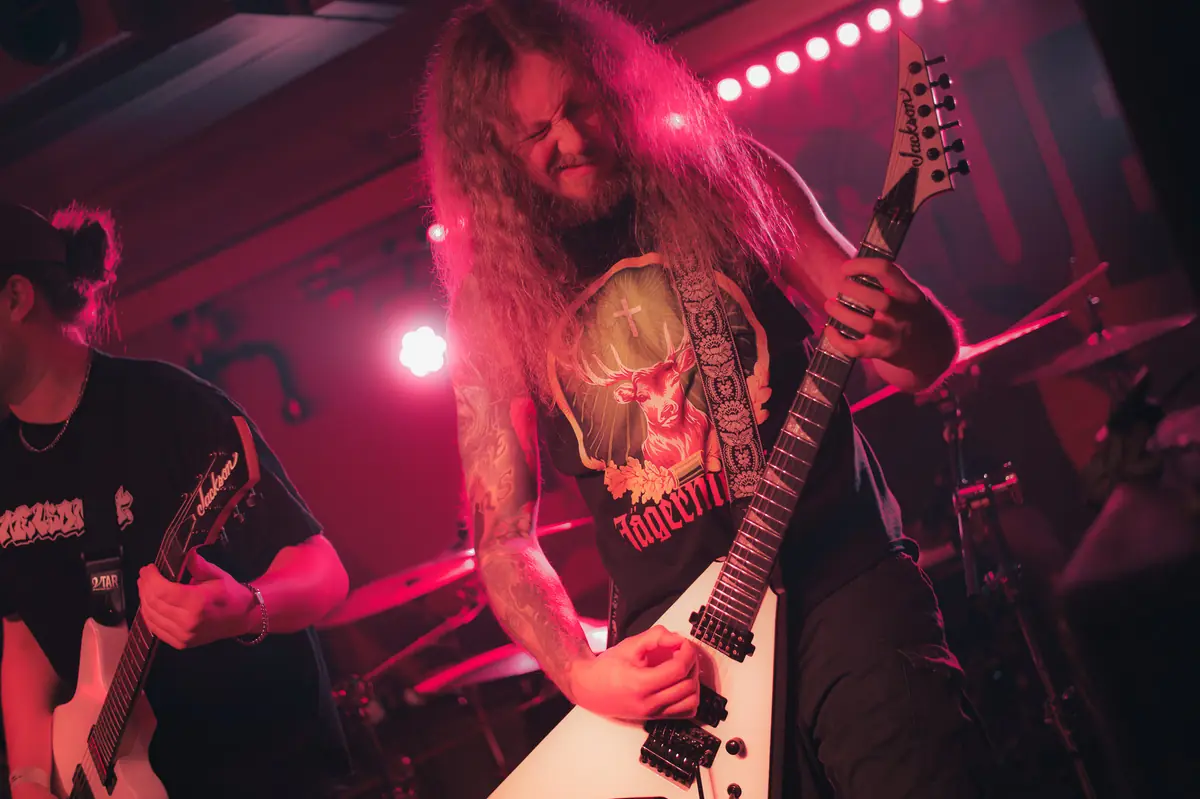
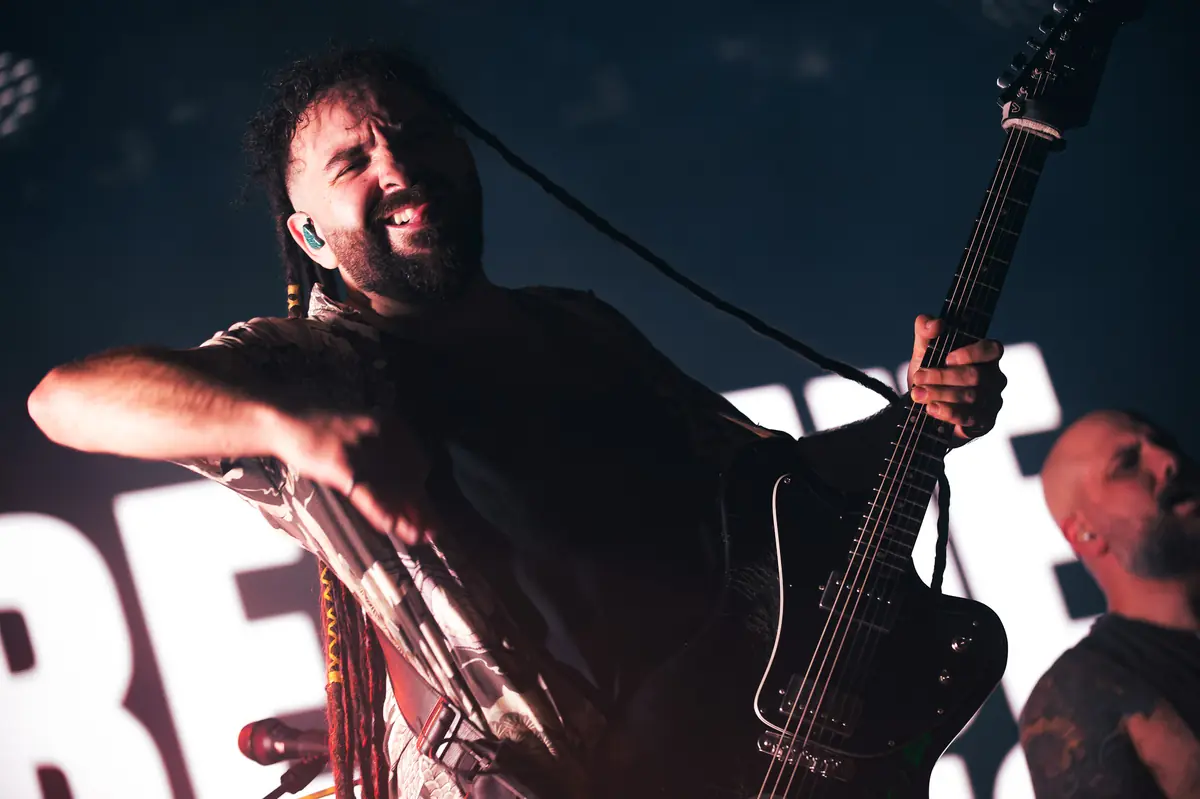
One of the most interesting acts to come out of the United Kingdom is Wytch Hazel. And since they performed at Wacken Open Air, we had the chance to chat with them.
Benedetta
Hello guys, how are you doing guys today?
Wytch Hazel
Very good, very warm.
Benedetta
And you’re playing Wacken in the legendary 35th anniversary edition. How do you feel?
Wytch Hazel
It feels exciting. I’m 35 years myself, so it feels quite special. I was born when Wacken was founded, so it’s very exciting. It’s meant to be. I’m actually quite honoured as well. I think we mentioned in this festival, early in the band, one day we’ll hope to play Wacken and then years later, finally we’re here. It’s crazy, isn’t it? It’s a privilege. It’s a great show as well. The crowd are lovely. Really cool.
Benedetta
So, you have obviously a lot of experience in playing live shows, but you also are experienced in the studio working on music. Do you think that the life of an artist is a lonely life?
Wytch Hazel
Depends how you live it, I’d say. We don’t tour quite a lot. We still have full-time jobs, so we just live like normal people. We have partners we come home to, and pets, and family. To us, for me personally, it doesn’t feel lonely. When we are touring, we all get on so well. It doesn’t feel like isolation. Sometimes it’s nice to be on your own. I’m quite an introvert, so sometimes it can be too many people. It’s nice to take yourself away and put your needs out here. I think we’re all pretty grounded by now. We can be around people and talk. Other times, we’ll take ourselves away and just be at peace, I guess. We all live in the north of England, don’t we? Where there’s lots of nice walks, if anyone wants to visit.
Benedetta
Do you think that we will ever reach some equality between men and women in the metal world?
Wytch Hazel
We’d like to think so. We’re all advocates for equality, really. I think we’re seeing signs of positive change. I’ve seen a lot of more female-fronted bands. People are wanting that, the catalyst for it is that the fans want that. It’s cool. We want variety. I think there’s a lot of positive steps forward. Loads of legacy bands are recruiting women now to replace members that are leaving as well, which is obviously positive. You just need more women to do it: more women see it, more women feel like they can join in. We’re getting there, I think. I’ve noticed quite a lot of positive attitude. I feel like that’s moved on. I always like to think that when I see someone playing a stage, that’s an excellent musician. I don’t say that’s an excellent female musician. That’s the sort of attitude we should all be taking. Everyone should be welcome. I’m looking forward to seeing a few bands that are actually playing. I saw Castle Rat, we played with them in France, didn’t we? They’re pretty cool. We actually stole some of their stage gear. We were all dressed in white white, and they had a white dress, a wedding dress. They were rushing around just before their set and we took the wedding dress. We didn’t steal it on purpose, because we were dressed in white, we thought it was ours. Most bands don’t have white clothes. We just picked up all the assorted white cloth and shoved it in a suitcase. They were cool about it, to be fair. But we gave it back as soo nas we realized our mistake.
Benedetta
Guys, thank you so much for taking the time to do this. Is there anything else that you want to add to our viewers and readers of fan metal?
Wytch Hazel
Just keep supporting music, underground music scenes. Probably not just in heavy metal genre, I think. We’re really grateful for that, so please continue.
Nottingham opens its gates to 40+ bands and a horde of Heavy Metal enthusiasts for Mangata Festival 2026.
Deer, double-ended dildos, headbanging to club Metal and doing the robot to grindcore, and paint. Lots of paint. Some of it demonic, some of it clown, some of it staying on the bands, and some of it rubbing off on eager moshers. This is Mangata 2026, a festival full of surprises, the good, the mad, and the emotional.
Best friends Kris and Laura from Mangata Music pulled together a variety of bands, from comedy Metal’s finest, Raised By Owls and industrial nu-Metallers Red Method, to Deathcore titans ten56., who ripped riffs from rooftops and dug screams out of the deepest depths of the underworld.
It was a headbanging delight. Here is what went down.
King Abyss
There is no time of day that a tasty slathering of aggressive Thrash cannot immediately improve, but unfortunately not everyone has dragged their arses out of bed to be reminded of this fact by King Abyss.
King Abyss – Mangata Festival 2026, Nottingham. Photo: Matt Pratt/MetalTalk
No matter, for the British riff brutes stomp through their 30 minutes on the Twisted Tavern Spirits Stage with a Hardcore edge that threatens to summon some two-steppers to the front. Alas, the curse of opening a festival means such threats do not always materialise, even with absolute belters like In The Ground.
Frontman Dom Bould makes it seem like it is entirely his choice to remain off the stage for their whole set, charging back and forth like an apex predator eyeing up his prey, with the rest of the five-piece filling the stage and pounding out menacing riff after menacing riff.
King Abyss – Mangata Festival 2026, Nottingham. Photo: Matt Pratt/MetalTalk
Bould forgetting which song is next adds a splash of laughter to the otherwise big, gnarly, chest-pounding performance that may not have caught the attention of every Mangata punter, but that is their loss.
Long live King Abyss.
Wolves Don’t Sleep
Opening Mangata’s Heavy Metal Hairdresser Stage, aka the main stage, are Nottingham locals Wolves Don’t Sleep, whose Metalcore is as sharp as it is heavily crushing, and instantly snaps the crowd awake.
Wolves Don’t Sleep – Mangata Festival 2026, Nottingham. Photo: Matt Pratt/MetalTalk
The darting white lights and punching rumbles from every bass lick make it feel like an air raid has commenced, with the feral soundscape enhancing the crowd’s feeling of excitement at this early-day festival find.
When half the band get on their knees, it is for a moment of melancholy as they move into a love song, Fears & Fractures. And while it may slow the pace, the intensity of this heartstring-ripping anthem foreshadows a day in the not-so-distant future where Wolves Don’t Sleep are playing not to handfuls of phone lights waving through the air, but thousands.
Wolves Don’t Sleep – Mangata Festival 2026, Nottingham. Photo: Matt Pratt/MetalTalk
That they are still playing shows where you can stroll to the barrier without hour-long queues or well-intentioned shoulder barges is a sin, but one that needs to be taken full advantage of, for this is a band ready to explode.
Gürl
“Are you ready to rave like it’s 4 am?” asks Gürl’s singer Joshua Dalton in a husky (or should we say Hexy) voice. It is time for some bitch Metal for bitches who like to dance while headbanging, and Gürl eye-up the sea of curious Metalheads with sassy appraisal. They will either get these hips moving, or die trying.
These hips don’t lie, because after half an hour with Bristol’s catchiest club Metal band, even some of the crowd more likely to end a show with a subtle head nod of approval are bouncing up and down like drunk teenagers on a trampoline.
Gürl – Mangata Festival 2026, Nottingham. Photo: Matt Pratt/MetalTalk
Unexpected breakdowns and guitar shredding solos in Evil Twin from Jonny Turner mix with gospel-esque harmonies in Medic, lots of songs about shagging, and even a questionably legal Dani Filth soundbite.
When bassist Jay Parker announces she has lost an ear, Josh explains that she is a cyborg and that is why she’s so attractive. Also, she did not lose her actual biological ear, just her earpiece, which is understandable as she has been owning the stage with her back-bending (literally) bass playing.
Gürl – Mangata Festival 2026, Nottingham. Photo: Matt Pratt/MetalTalk
It may not have been a rave at 4 am, but a party with Gürl at 1:10 pm slaps just as hard.
tealdeer
From referring to their music as “ominous deer anthems” to stunts like wearing a four-man T-shirt around Bloodstock Festival last year, alt-Metallers tealdeer are nothing if not tantalisingly unpredictable.
Frontman Ted Claxton starts their set by weaving through the crowd, one of many crowd strolls he takes, to make sure everyone puts their hands up.
tealdeer – Mangata Festival 2026, Nottingham. Photo: Matt Pratt/MetalTalk
Then suddenly a man in a deer mask is jumping around on and off the stage, which makes complete sense because this is a deer band. While the mask is not teal coloured, it does transpire that this Ominous Deer Man is the fucking idiot guitarist who broke his arm doing karate moves he learnt off Tekken.
All of this bonkersness only adds to the sheer brilliance of their music, which bounces through Post-Hardcore, grooved-up Metalcore, and occasionally something stranger like…carnival music?
tealdeer – Mangata Festival 2026, Nottingham. Photo: Matt Pratt/MetalTalk
Throat-shredding screams are complemented by gravelly cleans and three-way harmonies that make you want to drill new holes into your brain for greater sound absorption. The crowd is having a whale (deer) of a time, and when Whitney Houston’s I Will Always Love You starts playing, only to be interrupted by a roar from Ted, laughter permeates through the crowd. Not for the first time, nor the last.
With their absurd crowd engagement tactics and increasingly addictive music, tealdeer get even the grumbliest of back row punters breaking into a grin.
Ofnus
“Ofnus have one goal in mind: to reunite you with your misery through atmospheric black Metal.” Such a premise should not be so deliciously enticing. But the Welsh five-piece attract a mighty crowd that edges towards the stage like a group of zombies clawing at the life-emitting wonder before them.
This is a band with a vision that transcends mere individual experience and turns shattering shards of sound into moments of catharsis. Sorrow-stricken melodies dance with shrieks so raw and loud you can hear Ofnus’ new singer Brendan’s tonsils scraping against his throat.
Ofnus – Mangata Festival 2026, Nottingham. Photo: Matt Pratt/MetalTalk
There is even a point where they seem to veer towards black ‘n’ roll, before immediately reigning in the roll and plunging straight back into the atmospheric black void of an epic cinematic battle score.
When Brendan asks for Nottingham to give him their hands, he does so in such a way you feel compelled to chop off your limbs and surrender them to the five “dreaming men” on stage.
The crowd headbangs with utter abandon until the moment of inevitable loss arrives. As Ofnus announce the end has come, chants of “Ofnus! Ofnus!” boom from people who may not yet have fully confronted their misery, but have been convinced that they want to.
In Search Of Sun
If Backstreet Boys had decided to pivot into a rock band with a focus on twirling riffs, they would have sounded something like In Search Of Sun. It is Alternative Metal that they have rather ingeniously described as “bop Metal”, and while some of their songs, like In The Garden, are cheeky earworms that burrow deep on record and elicit big, bouncing crowd cheers from the stage, others, such as Ariel, are the retreat into pop territory that would have been better left in the idea factory.
In Search Of Sun – Mangata Festival 2026, Nottingham. Photo: Matt Pratt/MetalTalk
However, the Londoners are absolutely having the best time on the Heavy Metal Hairdresser Stage, and it is Contagious. They grin even when no one seems to have the brain power to remember the ten words they wanted help with singing, and jump about the stage whilst a three-man bromance pit breaks out in the crowd.
Somebody, please see if In Search Of Sun would take a gig as a wedding band for an alternative couple because they would be an absolute hoot.
Red Method
“My world is painted in red.” When industrial groove villains Red Method take to the stage, for 40 minutes, the world becomes theirs. And they do not so much paint it as they do annihilate it with a red assault that cracks open at least two trap doors into hell.
It is like a party with Jason Voorhees, half of Slipknot, and a possessed, blood-thirsty Tarzan (if Tarzan was covered in paint, half-Gibraltarian, and screamed in a Metal band).
Red Method – Mangata Festival 2026, Nottingham. Photo: Matt Pratt/MetalTalk
Bulldozing drums smack through sampling straight out of a Saw trap while Alex Avdis weaves sadistic tales on his keyboard, and the guitars add gruesome grooves that become something to cling onto amidst the demonic onslaught coming out of J S.A.N.G.R.E’s mouth.
And then there is the crowd invasion. It is impossible to keep track of which band members are playing inside the whirling vortex of moshing, flying limbs, and which are carving out a technically charged monolith of chaos on stage.
Detonate, Messiah, Counting Corpses, Cycle Of Violence. Red Method’s discography is swarming with songs that light a match under the furious part of your brain that delights in disorder.
Red Method – Mangata Festival 2026, Nottingham. Photo: Matt Pratt/MetalTalk
With every inch of fervour the crowd throws at them, Red Method spit it back tenfold. By the time J returns his borrowed cowboy hat (who knows, who cares, amen to the chaos) and has barely a lick of paint left on him – so covered in sweat is every inch of his body – the Heavy Metal Hairdresser Stage shudders with a sigh of sad relief as what may have just been the greatest set of the day comes to an end.
Raised By Owls
What time is it? It is comedy Metal time, and the Heavy Metal Hairdresser Stage is positively heaving with contestants eager to join the Big Metal Gameshow shenanigans hosted by Raised By Owls.
“What the fuck is wrong with you all?” asks frontman Sam’s Mum’s son, after loud cheers answer his question of who has seen them before.
The self-deprecating grindcore nutcases have nailed the art of appealing to the competitive child within us all whilst simultaneously chucking out a destructive torrent of blast beats, frantic riffs, and screeches that actually make up a really great live Metal cocktail.
Mr Blobby dazzles with his double-ended dildo twirling (apparently this is harder than it looks and should be regarded with the utmost awe), before he morphs into Cocknose from Slipknot to present three prizes, which will be competed for in the form of a headbang-off, crowdsurf-off, and dance-off.
The star of the show ends up being the security guard who puts up with every single second of this insanity with a smile on her face, and she is subsequently rewarded with a T-shirt that says, “I got my clit pierced at Claire’s Accessories”, an ode to Sam’s own Claire’s Accessories piercing.
It is 100% the silliest thing you may ever take part in in the name of Death Metal, but in the wise words of Raised By Owls: Live, Laugh, Lars.
Maatkare
Pharaohcious, formidable, and grounded in an ancient brutality, Maatkare lead a Death Metal reckoning out of the cosy confines of the BSB TV Stage.
Named after one of Egypt’s most powerful female pharaohs, Hatshepsut (who used Maatkare as her throne name), this band use the slaughterous power of Death Metal to celebrate all the phenomenal women who came before them and inspire the unde-nile-ably awesome women who will come after them.
Maatkare – Mangata Festival 2026, Nottingham. Photo: Matt Pratt/MetalTalk
Vocalist Janneke screams with a thunderous venom and ravages the small pub until everyone is ready to journey with them down to the underworld. Even the way they play with tension and atmosphere is visceral. Bungee-chord riffs and shackling drum blasts pull you in only to release you into a hungry, cavernous darkness.
One crowd member seems to be having an out-of-body experience for the entirety of their set, so blown away by how “holy shit good” they are.
Maatkare – Mangata Festival 2026, Nottingham. Photo: Matt Pratt/MetalTalk
The time of Maatkare the Pharaoh may be long over, but the time of Maatkare the band has only just begun.
ten56.
ten56. drove a whole day to be here, so when they ask for face-smashing pits, they will not stop until they get them. And while the room has not been heaving since Raised By Owls, the face-smashers show their faces, and come out to play with the French Deathcore unit.
ten56. – Mangata Festival 2026, Nottingham. Photo: Matt Pratt/MetalTalk
ten56. in three words would be: Filthy. Fucking. Breakdowns. They hit with a force live that is borderline impossible to recreate on record, but there is definitely a lack of star factor (and bodies) for tonight’s headliners.
Continents
Welsh Metalcore bruisers Continents bring it home for Mangata Festival 2026, with a furious, face-slapping set in a tight space that they refuse to be smothered by.
Ever since their comeback in 2022, they have been working back up to the killer live reputation they had been building on tours with the likes of The Ghost Inside and Comeback Kid, and reeling in new fans on top of the old.
Continents – Mangata Festival 2026, Nottingham. Photo: Matt Pratt/MetalTalk
Packed with searing emotion that frontman Phil Cross screams out with more serrated screams than a heavy-duty cheese grater, we are reminded why they garnered an influential status ten years ago and why it is desperately vital we see them continue.
The infectious beats, dirty riffs, and abrupt song endings that suck all the air out of your lungs keep the set momentum in a constant state of climax, whether it is newer tracks like Smile or old favourites like Pegasus, Pegasus.
“This represents social anxiety, and the gas lamp is both gaslighting AND the light to always guide you out of the darkness,” Phil explains while holding up a cardboard ghost. It is the ghost of their Lifeline EP, a brutally honest and haunting release that marked their emotive return following a necessary, life-saving, mental health break.
Continents – Mangata Festival 2026, Nottingham. Photo: Matt Pratt/MetalTalk
Continents have barely struck their final notes when Starship’s Nothing’s Gonna Stop Us Now fills the room, a gloriously cheesy, heartfelt way to say goodbye to Continents and to this year’s Mangata Festival.
Mangata Festival 2027 early birds have been snapped up already. Keep an eye on MangataFestival.co.uk as more tickets will be released soon.
Mangata Festival returns to Nottingham on Saturday 4 September 2027 for another day of heavy music, glorious mayhem and discoveries across the city’s intimate venues.
Event Details
Mangata Festival returns to Nottingham on Saturday 4 September 2027 for another day of heavy music, glorious mayhem and discoveries across the city’s intimate venues. The lineup is still to be announced, but tickets are already on sale. Visit MangataFestival.co.uk for updates.
Kamelot are a band not aversed to a concept record, they released a fair few in their time, the storytelling and thematic aspects suiting the dramatic and theatrical and cinematic sound the American symphonic metal band have been the forefathers of for thirty years now.
Their new album is set within the walls of Ravenhill Asylum, during the Victorian-era, the former cathedral is now a place where these dark, compelling stories unfold. The long time line up of founder Thomas Youngblood (guitars), Oliver Palotai (keys), Sean Tibbetts (bass), Alex Landenburg (drums) and Tommy Karevik (vocals) are well gelled now, each virtuosos in their own right.
They give Kamelot their signature style of melodic, progressive, power and symphonic metal, that is crafted into the anthemic tracks you hear here and across their discography, all made to sound huge by producer Sascha Paeth (alongside additional guitars) and mix/master extraordinare Jacob Hansen, bringing the full force of this record to your ears.
The title track is massive, euro metal gallops and colossal choruses, these returning on The Sleeping Mind (Orphic Paradigm), while on the other side of the Kamelot songbook there’s drama on Kaleidescope, balladry on Cassandra’s Disease while there’s Celtic tones on Ivy, My Dear and Enigma (Think Of Me).
Dark Asylum features a host of guests, as many Kamelot records have in the last, it’s become something if a calling card for the band, usually giving harsh vocals or as duets between different characters and that doesn’t change in Dark Asylum as they have some old and new joining them.
These include the current Miss World Chile, Ignacia Fernández of Decessus, Visions Of Atlantis singer Clémentine Delauney, both featuring on the anthemic Sanctuary, however on the dramatic One Last Masquerade the unmistakable tones of Avantasia/Edgy genius Tobias Sammet.
There’s also violin from Lea-Sophie Fischer of Eluveitie and evocative additions from Rannveig Sif Sigurðardóttir and Sólveig Sara Leupold on the Icelandic folk of Beneath The Moon (Tunglið), all these guests bringing their own unique sounds to the record adding positively to the overarching story.
Kamelot bring so much experience that the chances of any weakness are very low, and yet again they create another exemplary symphonic metal record. 8/10
Exumer – Death Mask Messiah (Metal Blade Records)
When we talk about the US thrash scene we often mention the ‘Big Four’ but Germany too has it’s own ‘Big Four’ usually Kreator, Sodom, Destruction, and Tankard are the bands peirll include but I would say there’s a very strong argument to replace one of them with Exumer.
They are a German thrash band that formed in 1984 however perhaps their excluding factor was that they broke up in 1991, however after reforming in 2009 they released their third record in 2012 and now in 2026 they bring us Death Mask Messiah their fourth full length since reforming.
Produced by Dominic Paraskevopoulos (Kreator, Caliban) and mixed/mastered by Arthur Rizk (Soulfly, King Diamond), Death Mask Messiah is a record with aggression flowing through it, while their albums post reforming have seen them attempting to sound like a modern band with original thrash roots, this new record steios back some of the modernity, opting for head banging thrashing.
It’s definitely their most 80’s sounding material, although with modern production, it still has a rawness that comes from the new rhythm section of Alex Voss (bass) and Jerome Reil (drums) who set a youthful pace for guitarists Marc B and Ray Mensh to try and match on Serpents, Frozen Ground and Fratricide.
With this muscle behind him, Mem V. Stein’s vocals are still strong as ever, probably more versatile now than they were in the 80’s, as he sings of misinformation, the Waco Siege and all manner of ideological, political and environmental (Ravishing Waste) ideas. He’s joined by Nasty Ronnie of Nasty Savage on a cover of that bands song Unchained Angel.
Death Mask Messiah is the sound of thrash band who are resolutely in their second life and proving that they should no doubt have the same reverence as their fellow Teutonic Thrashers. 8/10
Audrey Horne – Achilles (Napalm Records)
Norwegian heavy rockers Audrey Horne are band and all is right with the world, myself and a former contributor to this publication have been big fans of the band for a number rof years now, always excited when a new record of there’s drops. One hasn’t dropped once 2022’s Devil’s Bell, due to guitarist Ice Dale being needed in Enslaved is assume but now they launch their eighth record, Achilles but like there titular inspiration will it have a fatal flaw?
Well we’re into a good thing with the Title Track as Dale and Thomas Tofthagen let the retro rock riffs do the work as they bring some Zeppelin inspiration (you can probably guess the track from the riff) to start the album strongly.
We take a journey into the strutting twin harmonies of the 80’s with In The Eye Of The Hurricane, the choppy guitars that remind me of Rudolf and Matthias, the rhythm section of bassist Espen Lien and drummer Kjetil Greve, bring the groove, pace and power to Vampires, which has to be a lost Maiden song right?
Lipen also takes lead vocals for Lizzy-like strut of God Damn Beautiful, giving the triumphant tonsils of Toschie a rest, though he again shines like always, perfecting a balance between some of the best heavy rock singers from the 70’s and 80’s, (with a lot of Glenn Hughes) and it’s this understanding and love of these classic bands that make Audrey Horne such a fun listen.
It’s never a copycat, it’s a jukebox of rocks best bands but on original songs that could have come off their definitive albums, each captured the way they sounded at their very best. Even their balladry on tracks such as Pretty Little Lies feels authentic and never saccharine, as they storm through tracks such as Running Through The Night which puts Deep Purple with The Sopranos in glorious union.
Audrey Horne never fail to make me smile and always make me bang my head, probably the best classic hard rock band out there today. Fatal flaw? Not on this Achilles, just rock n roll that could launch a thousand ships. 9/10
Static Abyss – The Dying Hunt (Peaceville)
Autopsy offshoot Static Abyss are now on their third studio album and thereby dispel any notion of this being just another vanity project outside of Greg Wilkinson and Chris Refert’s “day job” in the US death metal legends.
Static Abyss are not a death metal band, not a death metal band in the traditional sense anyway. If you’ve heard their previous two record the you’ll know they’re a doom band that adopts the evil, unnerving sound of death metal.
On third record The Dying Heat, which is the first not to have a rapid release. Their previous two albums had a year between them, this one has has a bit more of gap but still has urgency, they’ve enlisted Necrot’s Chad Gailey on the drums, keeping up their tradition of having death metal musicians as part of the band.
With the doom tag stretched by the opening track Skull Blasted, it’s with Lobotomized At Last that they slow at the end finally adding the doom to death which continues on the ominous title track. Static Abyss though never get too far away from their history as even when they slow things down it’s not for too long.
No 20 minutes funeral dirges here, just some glacial frost and chilling grooves such as Bleeding In The Fog and Nowhere Forever that joins the blizzards such as Wall Of Delusion and Once A Corpse (Always A Corpse), none of the cuts going longer than five minutes but packing in riff after riff.
Static Abyss’ third album isn’t a huge step in any evolutionary direction, it’s just more death doom from these scene veterans. 7/10
Today, Bryan Adams announces ‘How’s It Goin’‘, his new studio album and a deeply personal musical love letter to Canada, arriving November 6th, 2026, via BAD Records. Rooted in the people, places, landscapes and stories that have shaped his home country, ‘How’s It Goin’‘ sees Adams turn his unmistakable songwriting and voice towards home. Drawing […]
Heddy Edwards’ Fever, Can Believe It is a dreamy and intimate indie pop track that gradually unfolds into something far more euphoric. Soft, atmospheric passages give way to shimmering synth-pop choruses, creating a strong sense of emotional release as the song progresses. The cinematic production complements the intimate songwriting, while Edwards’ distinctive vocal presence adds character and vulnerability to the performance. The arrangement reaches its peak with a powerful 80s-inspired belted outro, giving the track a dramatic final lift. A beautifully escalating piece of indie pop that balances tenderness, atmosphere and cathartic energy.