Peter Koller has checked in with an update.
The post Sick Of It All Are Working On Continuing On Together, Per Lou Koller’s Last Wishes appeared first on Theprp.com.
Peter Koller has checked in with an update.
The post Sick Of It All Are Working On Continuing On Together, Per Lou Koller’s Last Wishes appeared first on Theprp.com.
Reviewed by Matthew Williams
One of the many joys of writing album reviews is the amount of selection we get to choose from, so when I saw some industrial metal available, I couldn’t resist a bit of a delve into a genre that I’ve always loved. There’s something about huge industrial beats, dramatic drums, crushing guitars and pounding bass that I enjoy, so I was intrigued by this one.
GodFrost are based in Tokyo, with Frost contributing guitar, bass and programming, with guest vocalists Luna Midnight and Sara. Both bring a different sound to proceedings, with Luna kicking things off on opening track “Nefarious” and it’s got pretty much everything you want from an industrial metal song. The vocals add variety over the hypnotic beat with an almost nu-metal style rap in-between the cleaner words.
Sara adds her prowess on the next two songs, “Escape from Reality”, which is slowed down, and has a menacing element, before her higher tone bursts over the top, like a temptress luring you into her trap. It’s emotional and contrasts well to Luna’s style, as the raw, cold and atmospheric music whirls around in the background. “Hanging Doll” sees both credited for their vocal and lyrical contribution, and again it offers a slower paced beginning before the soaring vocals take over, with a spooky spoken word element incorporated into the track.

Signed now to Brutal Records, the EP is impactful and innovative, mixing doom and gothic noises, and “Bloodcurdling Scream” has a proper 90’s industrial base to it. With a mix of low and high vocals from the returning Luna, it’s both heavy and engaging, as the intensity ramps up and the words and intermittent screams flow across the composition.
The final track, “Seasons End”, caught me completely off guard, as the solemn, sobering somewhat melancholy track, doesn’t follow what has already happened. However, it is sung with clarity and feeling by Luna once again and provides a stark contrast to the harsh industrial nature of the previous songs, yet it allows the music to flow effortlessly as the words are both dramatic and heartfelt.
For all the latest news, reviews, interviews across the heavy metal spectrum follow THE RAZORS’S EDGE on facebook, twitter and instagram.
The post EP Review: GodFrost – Hanging Doll appeared first on The Razor's Edge.
(written by Islander) I originally made six choices for this column, but as I did yesterday I overslept due to having a bit too much fun last night at a local watering hole. So, I’m rushing now and am forced to leave two of my choices behind — and to cut this introduction short. As […]
The post SHADES OF BLACK: DIE SÜNDE, THE AEONS TORN, SERVANT, FLAME appeared first on NO CLEAN SINGING.
Reviewed by Oli Gonzalez
When we think of heavy music, several bands come to mind. Yob, Sunn O))), Meshuggah. There’s some that may not come to mind. Like Emma Ruth Rundle. Before I lose you, let’s redefine what it really means to be heavy. Let’s take her 2021 full length ‘’Engine Of Hell’’ for instance. Tackling addiction, grief, and childhood trauma makes for pretty heavy subject matters to say the least! Not heavy in the same guttural vocals, down tuned distorted guitars, and ferocious blast beats are. But rather a heaviness that really speaks to the core of our beings.
That’s all part of Emma’s song writing philosophy, where she says ‘heaviness can come from the honesty within and just the emotional content’. Armed with just a piano, guitar, and a series of raw unfiltered takes, this may be one of the emotionally poignant and emotionally heavy albums you’ll ever hear! How can her upcoming record “These Killing Times” compare then? Will we see any of these trends continue?
Well firstly, we’ll see Emma returning to a full band set up – like on previous albums – with a star studded lineup of guest musicians (a topic we’ll return to later). Equally, we also see her maintain this poignant and direct approach with the piano being key to establishing a sombre undertone to the music in tracks like ‘Anvil’ and ‘Powerless’. Kind of necessary to convey Emma’s feelings of hopelessness whilst observing many of the natural disasters in her native USA and being unable to change that. Though she ups the ante and deploys the extra musicians in her arsenal to devastating effect, in particular during the choruses to engulf you, the listener, in walls of layers of cathartic distortion as dense as the topic itself. That speaks to Emma’s musical background, when she recalls being on tour with Red Sparowes in Europe, listening to drone metal act Earth on repeat and wanting to incorporate this textural approach in her own music. That drone inspiration and multi-faceted approach can be observed in ‘Human Kindness’, with the dynamics constantly shifting from mellow and ambient to sonic armageddon whilst the pace remains slow and marauding within this eight minute opus.

This sheer complexity of the music and lyrical content should serve as a warning and enticing prospect in equal measures. A warning to those wanting an easy listen and something more bubblegum, whilst making those who crave more substance and challenge from their music salivate like Pavlov’s dog! Every time you return to the album, you’ll notice something new. Whether that be a different background instrument, a new interpretation of the lyrics, or fresh appreciation for the work of art she’s produced! This applies to ‘Don’t Delay Heaven’, a personal highlight. What exactly is she referring to when she says ‘we here in Babylon, we don’t believe’? A yearning for a world not built on corruption and political tensions tearing the world as we know it apart? Perhaps a question best discussed over a glass of wine…
Part of that art is the list of musicians she’s assembled, including members of Tera Melos, Chelsea Wolfe, and Baroness. This adds firepower to the lineup for sure and some serious respect to boot! Though with so many musicians, the risk of watering down your own abilities and strength of your brand is always there. Though Emma’s voice is largely the only one we hear, aside from backing vocals in ‘Oceans Of Time’, thus ensuring her identity is constantly imprinted on each song and thus the album as a whole.
So, is “These Killing Times” the heaviest album this year? When we try to compare it to albums like “Descent” by Immolation, then the New Yorkers have the edge in terms of sheer pace and aggression. But if we’re judging solely on sentimental power and pure textural depth, “These Killing Times” is one of the most impactful and emotionally heaviest of all!
For all the latest news, reviews, interviews across the heavy metal spectrum follow THE RAZORS’S EDGE on facebook, twitter and instagram.
The post Album Review: Emma Ruth Rundle – These Killing Times appeared first on The Razor's Edge.

Alex Terrible spent yesterday morning writing a long, detailed argument about what happens when a musician with millions of followers answers back to the people insulting him. He opened it by saying he understands Ronnie Radke better than most people do. He closed it by asking whether he’s supposed to live by a different set of rules than everybody else just because he has an audience. It’s a more coherent case than the headline suggests — and within hours of posting it, he deleted the whole thing.
 STREAM THE METAL BREAKDOWN DAILY NOW:
Scott Penfold covers the latest hard rock and metal news on today’s Metal Breakdown Daily. Download the free Loaded Radio App on Apple iOS and Google Play and get it every weekday morning.
The Slaughter To Prevail frontman published two posts on Instagram on the morning of September 12. They are no longer up, but ThePRP captured both.
He opened with the line the whole thing will be remembered for: “I understand Ronnie Radke better than most people.”
Then the argument.
His description of the cycle: people come onto your page and leave comments designed to insult you, mock you, make you look terrible, or deliberately provoke a reaction. Then when you respond publicly to that exact comment — repost it to your story, make a post about it, simply because you want to defend yourself on your own platform — suddenly you’re the bully. Suddenly you’re the bad person.
He then quotes what he says comes next: “How could you do that to a regular person? You’re famous! You have millions of followers!”
His response to that is the core of it. He says he’s a human being like everyone else, responsible for his own words and actions, and that he fully understands what it means to write something publicly — that thousands or millions might see it, that people will respond, agree, disagree, laugh, criticize. He’s an adult. He understands his words have consequences.
What he rejects is being held responsible for what other people choose to write to him, or for what his own followers do afterwards in response.
His line on that: you have the freedom to say what you want, but that doesn’t mean you’re entitled to control everyone else’s reaction to it. If you decide to say something publicly about another person, especially directly on their page, be prepared for that person — and other people — to react.
And then the closer: “Am I supposed to live by some completely different set of rules just because I have followers?”
 LIVE & LOUD: Stream the World’s Hardest Radio Station 24/7
Here’s the thing, and it’s worth taking his argument seriously enough to find the actual weak point rather than dismissing the whole thing.
Most of what he’s saying holds up. If you go onto someone’s page and call them something, you have published that. The idea that publishing an insult is private and responding to it is bullying doesn’t survive much scrutiny.
But he quotes the strongest counter-argument himself — and then changes the subject.
“How could you do that to a regular person? You’re famous! You have millions of followers!”
He treats that as an unfair double standard. It isn’t, quite. It’s a description of asymmetry.
A critic writing to Alex Terrible is one person addressing one person. Alex Terrible reposting that critic is one person addressing millions. The words can be identical and the act is not the same, because the consequences aren’t remotely comparable. One of them gets a notification. The other gets an inbox.
He acknowledges this when he asks whether he’s responsible for what people on his page do next. But the honest answer is that he isn’t responsible for it and he does cause it, and those two things can both be true. Pointing a very large audience at a named individual has a predictable outcome whether you intend it or not.
He’s identified the best argument against his own position, quoted it accurately, and moved on without engaging it. That’s the hole.

The comparison isn’t arbitrary, and the two men have history.
Ronnie Radke has spent most of his career as one of the most divisive figures in heavy music. The substance of it, stated precisely:
His prison sentence came out of an altercation in which a man was killed during a fight involving several people. Radke was not charged with the murder — the charge was battery with substantial bodily harm, and a subsequent parole violation resulted in prison time.
He has also faced past arrests for domestic violence, the majority of which were later dropped, an incident in which fans were injured at a show involving mic stands, and a rape allegation over which he filed a defamation lawsuit and has publicly stated he won.
Separately, he has a long record of firing back at online critics directly and with considerable venom, which has generated its own controversy independent of anything else.
Alex Terrible’s own history is different in kind. He has documented past associations with neo-Nazism, which he has consistently denied ever subscribing to — telling ThePRP in August that he made some stupid mistakes and is not a Nazi. He has also faced allegations of homophobia over past social media commentary, which he likewise denies, having addressed both in 2023 and again this year.
The two are not the same set of accusations and nobody should pretend otherwise. What they share is the experience of being permanently derided in certain quarters online — and that parallel has previously pulled them together, with Radke publicly voicing support for Terrible during the backlash over the “Real Man” video in 2023.
So when Terrible says he understands Radke better than most people, he isn’t making a general point about celebrity. He’s talking about a specific man who has been where he is and who has already picked a strategy: hit back, every time, harder.
Terrible has generally gone the other way — exasperated rather than combative. Yesterday’s posts read like a man deciding which of those two approaches he actually wants.
We Recommend – Best Metalcore Bands: The 13 That Actually Defined The Genre
Which is the part nobody’s going to lead with.
He wrote several hundred words arguing that defending yourself publicly on your own platform is legitimate, that he’s an adult who understands consequences, and that he shouldn’t have to live by different rules because of his audience size.
Then he took it down.
You can read that a few ways. Someone in his circle may have advised against it. He may have decided the argument wasn’t worth having. He may simply have cooled off — which is the most human explanation and probably the right one.
But there’s an irony sitting in it that’s hard to ignore. A post about the right to speak your mind publicly, removed publicly, within hours. Whatever rules he thinks he should be living by, he blinked before the internet even got going.
Check Out – The 13 Greatest Frontmen In Heavy Metal History, Ranked
Worth the context, because the band are in the middle of a genuinely strong run.
Slaughter To Prevail have become one of the biggest names in modern deathcore, and Terrible’s own profile has grown well beyond it — his solo cover of Korn’s “Freak On A Leash” landed in August and did significant numbers.
The band added eight more North American shows to their fall run earlier this month, on top of a schedule that already had them across the continent.
Whatever else is true about him, the music is working. Deathcore has spent the last few years moving from the furthest corner of the genre toward something approaching the mainstream, and Slaughter To Prevail are one of the reasons why.

In a since-deleted Instagram post on September 12, 2026, the Slaughter To Prevail vocalist wrote “I understand Ronnie Radke better than most people,” going on to describe the experience of being criticised online and then being cast as the aggressor for responding publicly on his own platform.
He has not said. Both posts were removed within hours of being published, though screenshots were captured before they came down.
He has documented past associations with neo-Nazism, which he has consistently denied ever subscribing to, describing them as stupid mistakes. He has also faced allegations of homophobia over past social media commentary, which he denies. He has addressed both publicly on multiple occasions, most recently in August 2026.
The Falling In Reverse frontman served prison time following an altercation in which a man was killed — he was not charged with the murder, but with battery with substantial bodily harm, with a later parole violation resulting in imprisonment. He has also faced domestic violence charges, the majority of which were dropped, and a rape allegation over which he filed a defamation lawsuit and has publicly said he won. He is additionally known for responding aggressively to online critics.
The two have publicly supported one another. Radke voiced support for Terrible during the 2023 backlash over the “Real Man” video, and the pair have since collaborated.
A long argument about the right to answer back, deleted within hours of being posted. Was he right, or is the asymmetry the whole point? Tell me below. And keep it locked on the Loaded Radio stream — follow Loaded Radio for daily rock and metal news.
The post Alex Terrible Slams Internet Trolls and Says He Understands Ronnie Radke Better Than Most People appeared first on Loaded Radio.
Their latest single closed out their set.
The post Watch: Spiritbox Gave “Mourning” Its Live Debut At Their European/UK Tour Kickoff appeared first on Theprp.com.
As Gerard put it: “Finally, some real royalty in the house.”
The post My Chemical Romance Hinted At A New Album And Welcomed King Diamond Onstage In San Antonio appeared first on Theprp.com.


Appalachian singer-songwriter Jim Vest, the creative force behind contraceptives., turns differentlight. into a dark and introspective meditation on mortality and the complicated nature of love. The song explores the unsettling idea that people may receive more affection and attention once they are gone, approaching the subject with a restrained, melancholic atmosphere rather than easy sentimentality. Vest’s songwriting gives the track an intimate, reflective quality, while the subdued production allows the emotional tension to gradually sink in. There is a quiet discomfort at the heart of differentlight., making its message linger well beyond the final notes. A thoughtful and sombre piece of alternative songwriting from an artist using music to explore mortality, memory and human connection.
Connect:
Opeth had spent 20 years on the Swedish metal scene when they turned their attention to their 10th album. But 2011’s Heritage wasn’t more of the same – to the horror of some fans, they toned down the aggressive growling vocals and distorted guitars, and embraced the prog tendencies they’d always hinted at. That year, band leader Mikael Åkerfeldt talked us through the process.
You could say it was inevitable. Album after album, the death metal roots from which Opeth sprang were trimmed away, exposing a beautiful progressive rock blossom. And while the aggressive growls and heavy distortion were still tangible in albums as recent as 2008’s Watershed, there were always hints that a later release could erase their metallic inclinations.
Those hoping for a sign of brutality need only look at the cover of Heritage to give up. The artwork is an open invitation to a musical odyssey steeped in prog rock – a bountiful tree rooted from the depths of hell, built around a pastoral landscape, a flaming city in the background and a pit of skulls beneath. It’s a mammoth leap from the gothic imagery of yesteryear. Pure and simple, it’s Opeth’s proggiest album to date. Mankind might feel the tremors, but the leap is but a small step for frontman Mikael Åkerfeldt.
“It feels, without sounding pretentious, like we’ve been working our way up to this point since the first album,” he explains. “I did start writing stuff that sounded like a continuation of the last album, but I was kind of fooling myself. I had two songs and I ended up deleting them after Martin Mendez said ‘Man, that’s not good!’ He was on the same wavelength as I was, pretty much, I just needed a second opinion to get a kick up the ass. So I scrapped everything and started from scratch. The Lines In My Hand was the first song I wrote for Heritage, then I wrote the rest of the stuff in six or seven months and it was easy. I didn’t stop and think – I just wrote it.”
Be warned: Heritage is almost devoid of metal. Gone are the distorted guitar riffs and drum machine-style pedal action that leant itself to the Swedish death genre out of which Opeth were born. Clearly a brave step for a band who have been deemed heavy for 20 years; and possibly one that’s detrimental to their metal fanbase. “You can’t worry about those things,” Åkerfeldt says. “I think some fans will be disappointed – but we’ve done experiments in the past. If you know your Opeth history, this isn’t an outrageous album at all.”
Åkerfeldt essentially calls the shots, but there are four others in the merry band of brothers; and guitarist Fredrik Åkesson’s thoughts on the move from metal must be worth hearing. In fact, he’s in accordance with Åkerfeldt’s choice. “When I heard about the album I knew there wasn’t going to be any growls, and there’d be less distortion on the guitars and bass. The metalhead in me was like, ‘Are you really sure about that?’ but when I heard the stuff I was like, ‘Yeah, that’s a really cool vision!”
By shifting the focus from brutality to prog-drenched experimentation, Heritage opens up a new world to both fans and the musicians who play on the record. Without the oppressive effect of distortion, there’s leeway for other elements of the band’s sound to shine – especially for drummer Martin Axenrot.
“This time round everyone has their own space, especially Martin; he’s been aching to do an album like this fore ver,” says Åkerfeldt. “He’s only been known for his metal drumming but, he actually started out in a marching band and his drumming idol is Ian Paice. He’s never really had enough credit. So he’s all over this album doing rock, fusion, jazz and heavy metal. It’s great that every musician is there.”
Joining Opeth on Heritage are two notable guest musicians – Peruvian-born percussionist Alex Acuña from Weather Report and flautist Bjorn J:son Lindh, who’s worked with Mike Oldfield among others. “Alex was a bit of a coincidence,” says Åkesson. “A guy who was helping us with the drums knew we needed help with a percussion part, and also knew that Alex was in town for a drum clinic, so he told us about it. Alex is like, only the best percussion player in the world, so it was perfect!”
Lindh wasn’t so easy a coup; the band tried and failed several times to get him to play flute. But as he was in Stockholm when they were recording, he agreed to pop by.. Or As Åkesson puts it: “he did two takes then pissed off!” Perhaps unsurprisingly Lindh wasn’t the only famous flute player that Opeth had in mind for the record.
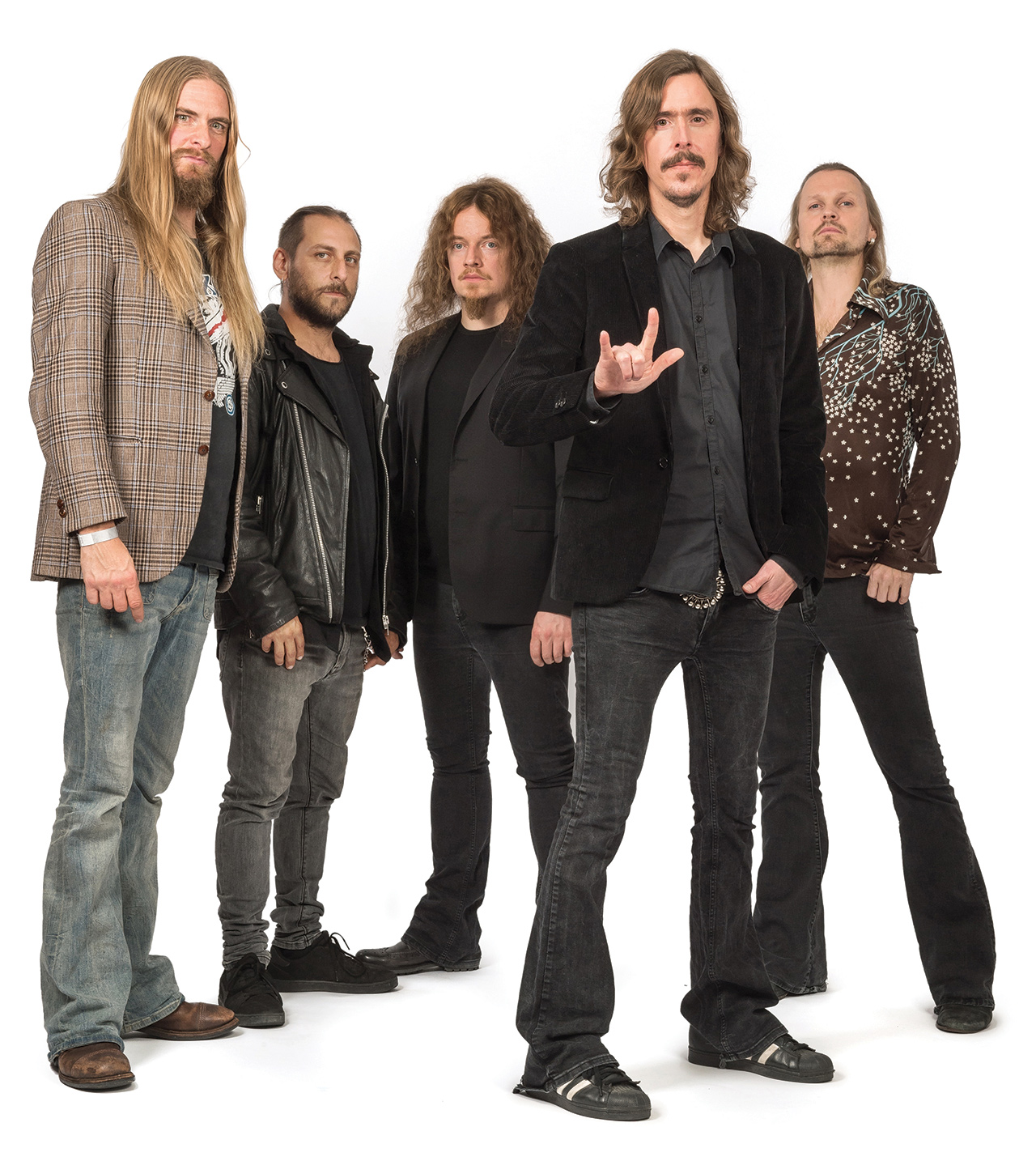
“I did email Ian Anderson but I never heard back. Funnily enough, when I went down to Steven Wilson’s place to mix the album, he says, ‘I just got an email from Ian Anderson. He just wants me to look into mixing Aqualung!’ But I’m really happy in retrospect that we have Bjorn, because it fits with the vibe of the record.”
One musician will not be revelling in the glee afforded by Opeth’s newest endeavour. Earlier this year long-standing keyboardist Per Wiberg left the band, the reasons for which may never be clear. Åkesson recalls Wiberg saying he’d “lost the joy of playing music” – but Åkerfeldt can’t help but feel there was something more personal involved: “I don’t think he felt comfortable with me having the final say on things,” says the band leader. “In fact, sometimes I felt like he despised me. He was calling up the other guys and going out to bars with them, but he never called me. We used to be really good friends.”
I asked Per, ‘Would you have left anyway?’ and he said, ‘Yes.’ That made me feel a lot better
Animosity doesn’t make the task of firing someone any easier. Åkerfeldt recalls giving his dispirited keyboardist his marching orders: “I fired him, and I got terrible panic attacks after that. I was doing it through email because I was bitter and angry. Then we started emailing back and forth. He’d never said more heartfelt stuff than he did in those emails. So I asked him, ‘Would you have left anyway?’ and he said, ‘Yes’. That made me feel a lot better.”
He’s delighted with the contributions of ex-Yngwie Malmsteen keyboardist Joakim Svalberg. Although not necessarily a permanent fixture (Åkerfeldt prefers to “take things slow”) the new recruit is already proving a hit. Anyone in attendance at recent gigs will testify to his pristine vocal parts. “Our voices fit together better than Per’s,” Åkerfeldt says. “But then Joakim’s very professional in that sense. He’s not going to do anything half-arsed. He’s so prepared. He knows all the lyrics – even I forget the lyrics! – all the harmonies, and he’s really into it.”
The band are certainly making the most of Svalberg’s prowess. The opening bars of Heritage are a sparse and delicate piano piece more befitting a woeful interlude than an album’s introduction. But like the cover art, it serves as a blatant indicator that Opeth are doing something different this time. It’s more than just a ‘less metal’ version of the band; you’ll find cheeky folk ditties, vocoder passages and ominous tribal drums conveying menace in equal measure – but in an entirely different way than in the past.
“I’ve never been a big fan of happy, uplifting music. But I think sorrowful music can be uplifting,” muses Åkerfeldt. “With the production of this album it was easy to bring those things forward musically. If you do the metal thing, the few emotions that are in there come from aggression; this time it was easier to tap into more profound feelings.”
Talking tabout his thoughts on the state of the current music scene, it’s evident that he feels uninspired by today’s metal offerings. “We’re the biggest metal fans ever, and that’s why we get a bit pissed off. The contemporary scene doesn’t really offer me anything right now. I take all my inspiration from older bands.” Which might be why Heritage is their least metal album to date. Åkerfeldt’s musical interests include metal, jazz and folk, but he also attributes influence from a person who’s proved integral in Åkerfeldt’s professional and personal life.
I was listening to Rainbow Rising and my eyes were tearing up. I was like, ‘How is this possible?’
“Steven Wilson played me an album by David Crosby that I hadn’t heard – his first solo album If I Could Only Remember My Name – and it blew my mind. It’s a jamming kind of record but it’s got the crème de la crème of the West Coast scene. Recently I went for what I like to call ‘an old man’s walk,’ where I go out and listen to music. I was listening to Rainbow Rising and my eyes were tearing up. I was like, ‘How is this possible? I’ve heard this a million times!’ Now it means more to me than ever. It’s those types of records – Rainbow’s Rising, Judas Priest’s Sin After Sin – I listen to a lot.”
There’s no doubt that Opeth will continue to reinvent their wheel at every turn. “A lot of people, once they have a career, get afraid of their own creativity,” Åkerfeldt muses. “They think they’re going to lose their jobs if they get creative. But I think our career is based on doing what we want, because that’s what we’ve always done.”


At just 13 years old, Iris Danbury shows remarkable maturity on Clown, her third single and a clear step into a more introspective indie-pop direction. Moving away from the pop-punk character of her first releases, the song unfolds as an emotional folk-pop ballad, balancing gentle Americana touches with a romantic, almost cinematic sense of scale. Her youthful voice brings an unfiltered sincerity to the songwriting, while the arrangement gives the track space to breathe and gradually build its emotional weight. Clown feels personal without becoming overly dramatic, capturing the vulnerability of feeling misunderstood and emotionally exposed. A promising introduction to a young songwriter already developing a distinctive voice and sense of storytelling.
Connect: